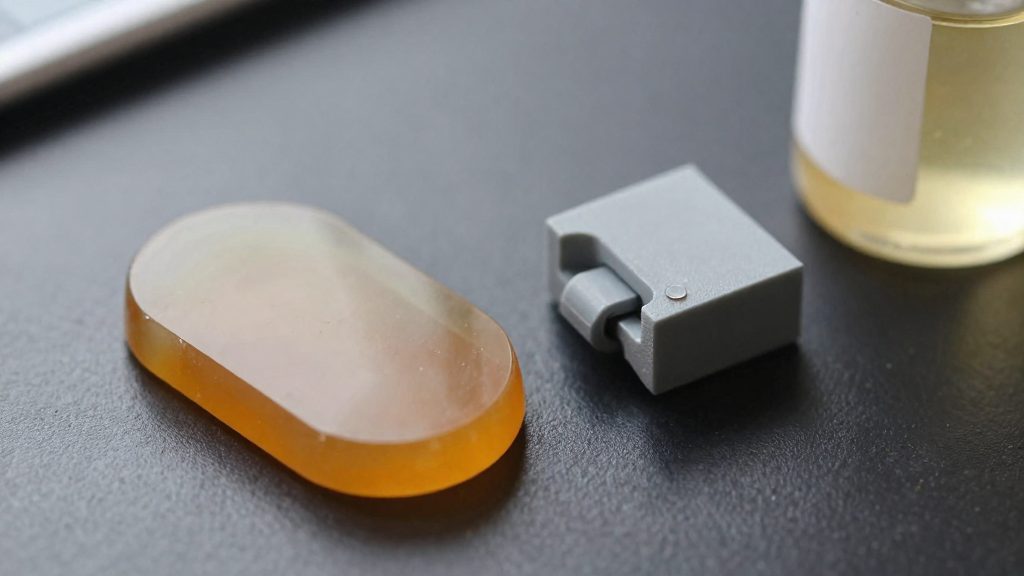
Standard and tough resins differ mainly in how they fail. Standard resins are aimed at general-purpose printing and surface quality, and most are relatively brittle. Tough resins are aimed at crack resistance: they deform before they break.
Standard vs tough resin: what is the real difference?
Standard resins are built around surface quality and general-purpose printing. Most are relatively brittle, and the impact behaviour is the main limitation. According to JLC3DP (2026), a high-strength resin is stiffer, and under impact it can crack suddenly instead of bending. For that reason, standard resins are not recommended for stressed parts or outdoor use.
Tough resins are designed for crack resistance. They bend before breaking, which suits snap-fits, hinges and parts that are likely to be dropped. The sources name Formlabs Tough 2000, eSun Hard-Tough and Siraya Tech Blu as examples of resins sold under this description.
| Property | Standard resin | Tough resin |
|---|---|---|
| Main focus | Surface quality, general-purpose printing | Crack resistance |
| Failure under impact | Relatively brittle, can crack suddenly if stiff | Deforms before failing |
| Typical use | Display and general prints | Snap-fits, hinges, drop-prone parts |
The tensile strength and elongation trade-off
Tensile strength measures how much pulling force a part resists. Elongation measures how far it stretches before breaking. These two values pull against each other: a resin that resists pulling force strongly often has less give, while a resin that stretches further usually gives up some stiffness. Tough resins accept that compromise in exchange for deformation before failure.
This is why the highest tensile value on a sheet does not settle the choice. For a part that must absorb a knock or flex repeatedly, the way the resin deforms matters as much as how much force it withstands. For a part that only needs to hold a shape and show fine detail, a standard resin is the more suitable match.
Is “tough resin” an official material grade?
No. “Tough resin” is a label chosen by each vendor, not a standardized ASTM or ISO grade. According to 3DMag (2026), two products sold as “tough” can differ in chemistry and mechanical performance, so the name alone tells you little. The practical method is to open each manufacturer’s technical data sheet (TDS) and compare the measured values.
Marketing names such as “tough” or “ABS-like” describe intent, not measured performance. Standard resins are built for general-purpose printing and surface quality. Tough resins are formulated for crack resistance and tend to deform before they fail (3DMag, 2026).
FacFox (2022) reports that, in its comparison, Formlabs Tough 2000, eSun Hard-Tough and Siraya Tech Blu show almost double the tensile strength of one standard resin, Anycubic. This is a comparison with a single product, not with all standard resins, and tensile strength alone does not show toughness.
Why cure state changes the numbers
The same resin can produce very different results depending on post-curing. 3DMag (2026) reports the following for Formlabs Tough 2000 V2:
| Cure state | Tensile strength | Elongation at break |
|---|---|---|
| Green (uncured) | 26.1 MPa | 149% |
| Post-cured | 40.4 MPa | 79% |
Strength is not the same as toughness
Tensile strength, elongation at break and impact resistance measure different things. 3DMag (2026) notes that higher tensile strength does not automatically mean a material is tougher. The test methods cited are ASTM D638 for tensile strength and Izod ASTM D256, Charpy and Gardner for impact.
How to read a resin data sheet
A resin’s technical data sheet (TDS) is the most reliable place to check mechanical behaviour before printing a functional part. For load-bearing parts, four fields matter most: tensile strength, elongation at break, the impact test results, and the heat deflection temperature (HDT). Each one measures a different property, so none of them should be read alone.
Tensile strength and elongation at break
Tensile strength is measured under ASTM D638 and describes the pulling force a specimen withstands before it fails. Elongation at break is listed alongside it and describes how far the material stretches before it breaks. Read the two together.
Izod, Charpy and Gardner impact results
These methods measure different things, so a result from one method cannot be ranked against a result from another. When comparing two resins, check that both sheets use the same method. A resin with a high tensile strength can still perform poorly in an impact test, which is why the impact line deserves its own check.
Heat deflection temperature
HDT is valid only with its stated load, typically 0.45 MPa or 1.8 MPa. A temperature given without a load, or with a different load than the one you are comparing, does not tell you how the resin will behave under your conditions. Before comparing two sheets, confirm the load in the test conditions and compare only values measured at the same load.
| Field | Test reference | What it tells you | Common misreading |
|---|---|---|---|
| Tensile strength | ASTM D638 | Pulling force before failure | Treating it as a toughness measure |
| Elongation at break | Listed with the tensile test | How far the part stretches before breaking | Ignoring it when comparing strong resins |
| Impact result | Izod (ASTM D256), Charpy, Gardner | Response to sudden impact, for that method only | Comparing results from different methods |
| HDT | Stated load, e.g. 0.45 or 1.8 MPa | Temperature at which the specimen deflects under that load | Comparing values measured at different loads |
When should you choose tough resin for functional parts?
Choose a tough resin when a printed part must absorb force rather than simply hold a shape. Standard resins are suited to general-purpose printing and surface quality. Tough resins favor crack resistance and deform before they fail, which is the behavior you want in a loaded part.
Stressed parts where standard resin is discouraged
Tough resins suit these roles:
- Snap-fits, which flex during assembly and must not fracture
- Hinges, which move repeatedly
- Drop-prone parts, which may hit a hard surface
If a part only holds a shape or carries a light, static load, standard resin remains the simpler choice.
Outdoor use
Standard resin is not recommended for outdoor use, so outdoor parts should be printed in a resin whose technical data sheet explicitly covers outdoor exposure. The sources consulted do not specify outdoor test results for individual resins.
Named tough resins against standard resin benchmarks
Formlabs Tough 2000, eSun Hard-Tough, and Siraya Tech Blu show almost double the tensile strength of Anycubic standard resin (FacFox, 2022). Tensile strength alone does not settle the choice, because it measures a different property from the others:
- Tensile strength (ASTM D638) measures the stress a specimen withstands before breaking.
- Elongation at break measures how far it stretches before failing.
- Impact tests (Izod ASTM D256, Charpy, Gardner) measure resistance to sudden blows.
Why post-curing changes strength
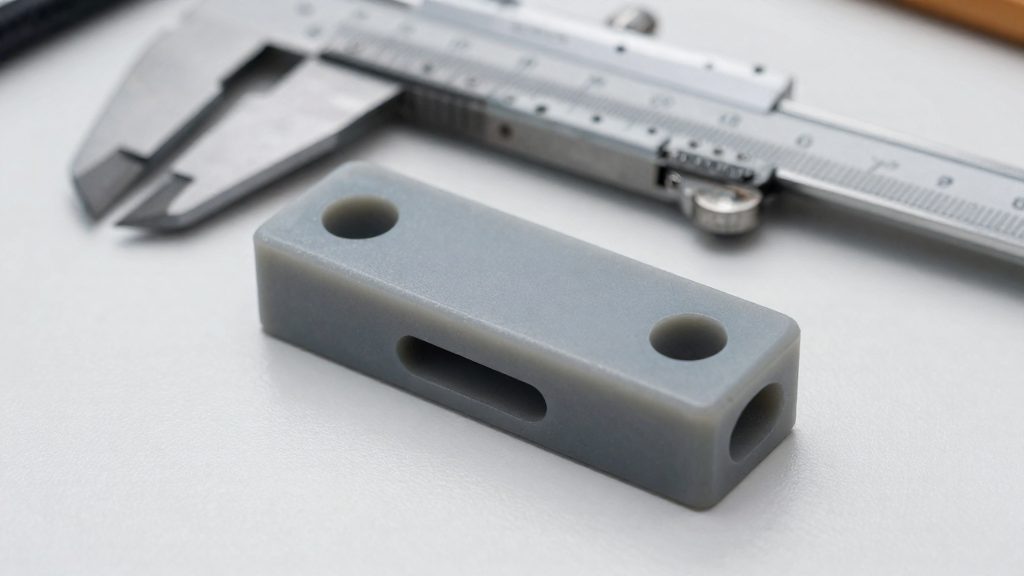
A printed resin part is not in its final state when it leaves the build plate. It is in the green state, where the resin is only partly cured, and its mechanical values depend on how far that cure has progressed. Post-curing completes the cure and moves the part toward the properties listed on the manufacturer’s technical data sheet. According to 3DMag (2026), the Formlabs Tough 2000 V2 shows the effect clearly:
| Property (Formlabs Tough 2000 V2) | Green | Post-cured |
|---|---|---|
| Tensile strength | 26.1 MPa | 40.4 MPa |
| Elongation at break | 149% | 79% |
The two columns show a trade-off. Strength rises after post-curing, but the part stretches much less before it breaks. The source gives no impact results for this resin, so nothing can be concluded about impact resistance from these figures.
Post-curing completes the cure, so follow the resin manufacturer’s post-curing instructions and check the TDS for the cure state it describes.
Why cured and uncured data sheets differ
Because cure state changes the numbers, a value on a data sheet is only meaningful if you know which state it describes. Two resins can look very different on paper simply because one datasheet quotes green values and the other quotes post-cured values. Compare the same property, in the same cure state, across the technical data sheets of each product.
Design and exposure mistakes that make parts crack
Cracked functional resin parts are often linked to three factors: hollowing, geometry that concentrates stress, and exposure errors that leave the resin too brittle to absorb a load. Each of these can be addressed before the print starts, in the model and in the slicer.
Hollowed models are unsuitable for functional parts
Hollowing a model saves resin, but according to FacFox (2022) hollowed models are unsuitable for functional parts. According to FacFox (2022), hollowed models are unsuitable for functional parts. Reserve hollow shells for display pieces. If a part must hold a bracket load, survive a clip action or absorb a drop, keep it solid and design its walls for the stress it will see.
Thin walls and sharp internal corners
Thin walls and sharp internal corners are common causes of failure, according to JLC3DP (2026). A sharp inside corner concentrates stress at one point, so a crack tends to start there and run through the section. Where the geometry allows, add fillets at internal junctions and thicken any wall that carries a load.
Parts that crack under load or impact
Tough resins such as Formlabs Tough 2000 or eSun Hard-Tough are the usual choice for these roles.
Match the resin to the failure you expect. A rigid part under static load behaves differently from a part that must flex and absorb an impact, so choose the resin family before you finalise the geometry.
Exposure choices that leave parts too brittle
Exposure errors change the mechanical result, not only the surface finish. According to JLC3DP (2026), overcuring raises brittleness and lowers impact resistance, while underexposure lowers tensile strength. Both errors weaken the part, so calibrate exposure time for your specific resin and printer rather than reusing a profile written for a different resin.
Build direction: resin vs FDM strength
Resin and FDM parts respond differently to load because of how they are built. According to FacFox (2022), resin parts are isotropic, so their strength does not depend on build direction, while FDM parts are weaker along the Z-axis, the direction in which layers are stacked. For a load-bearing part, the choice therefore depends on which way the load acts and on whether the resin is chosen for toughness rather than rigidity.
Build direction and layer bonding
On an FDM printer, the weak point is the layer interface. A load that pulls along the Z-axis works against the bond between layers, so orient the part so the main load runs within the layer planes (X/Y) rather than pulling the layers apart along the Z-axis. According to FacFox (2022), resin parts are isotropic, so build direction does not change their strength. Orientation can still affect supports and surface finish.
Strength is not toughness
JLC3DP (2026) distinguishes strength, toughness, and hardness as separate properties.
| Characteristic | Standard resin | Tough resin |
|---|---|---|
| Main focus | General-purpose printing and surface quality | Crack resistance |
| Failure behaviour | Relatively brittle | Deforms before it fails |
| Stressed parts | Not recommended | Suited to snap-fits, hinges, and drop-prone parts |
Choosing resin or FDM for load-bearing parts
- Identify the load type: static load, impact, or repeated flexing.
- For impact or snap-fit loads, favour a resin described as tough over a stiff, high-strength resin, which can crack suddenly.
- Check the technical data sheet (TDS) of the chosen resin.
- For FDM, orient the part so the main load avoids the Z-axis.
Frequently asked questions
Does print orientation weaken a resin functional part the way it does with FDM?
No. Resin parts are isotropic, so their strength does not depend on build direction, whereas FDM parts are weaker along the Z-axis (FacFox, 2022). You do not need to orient a resin part to protect a specific load path.
Why did my tough resin part crack even though the resin is labelled “tough”?
“Tough” is a vendor-defined label, not an ASTM or ISO grade, so it does not guarantee impact performance. Overcuring makes a part more brittle, and thin walls or sharp internal corners are common failure points (JLC3DP, 2026). Check your exposure settings and redesign those features before switching resins.
How do I compare two tough resins on their datasheets?
Read tensile strength, elongation at break and impact results separately, because higher tensile strength does not automatically mean tougher. Note whether the values are for green or post-cured parts, since the numbers change significantly after post-curing (3DMag, 2026). For heat resistance, only an HDT value with its stated load, such as 0.45 or 1.8 MPa, is meaningful.