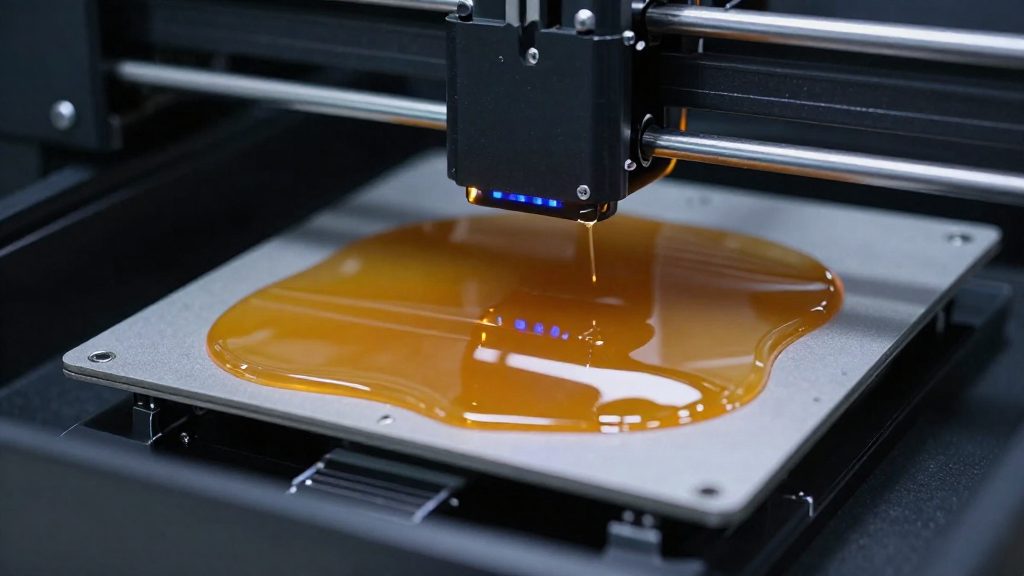
What does 405nm mean for resin printers
Wavelength is the distance between successive peaks of a light wave. It is measured in nanometres (nm), where one nanometre is one billionth of a metre. A 405 nm light source emits at that single wavelength, and a resin is formulated to react to light at a specific wavelength.
Because the wavelength is the most important single factor in whether a resin works on a printer (Formlabs, 2026), a resin designed for the printer’s 405 nm light is the best starting point. Formlabs states that a resin designed to cure under 405 nm light has a good chance of printing on its SLA printers, so the wavelength acts as the baseline for compatibility before any other property is considered.
| Item | Value in the sources | Source |
|---|---|---|
| Unit of light wavelength | Nanometres (nm) | General definition |
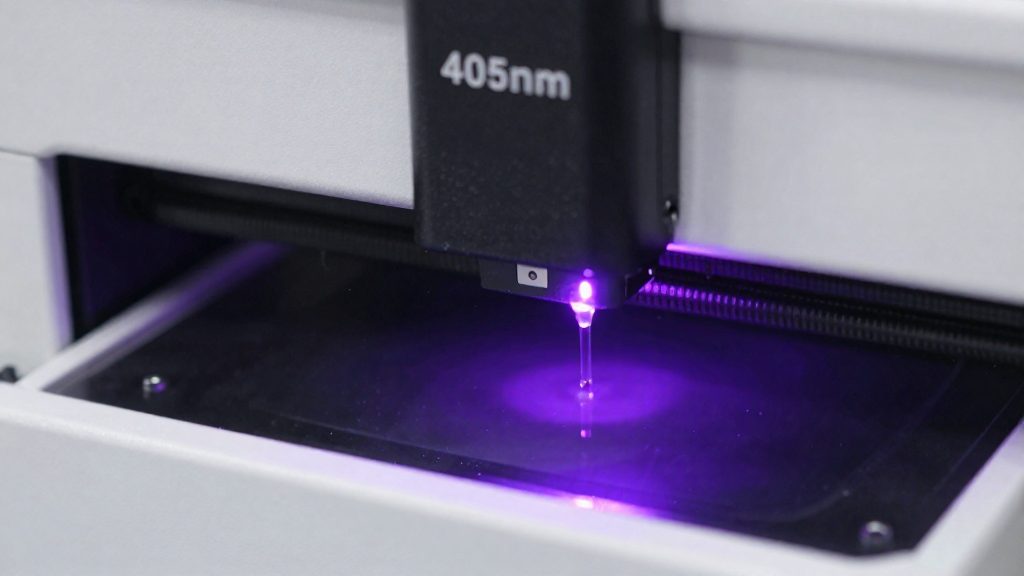
How resin cures under 405nm light
A 405 nm resin printer builds each object by curing liquid photopolymer one layer at a time. The light source projects the cross-section of the model onto the resin, and wherever the light lands, the resin solidifies into a thin layer that bonds to the one beneath it. The build platform then moves, and the next layer is cured. Repeating this cycle stacks the layers into the finished part, so the quality of each cure determines the quality of the whole print.
The role of photoinitiators
The reaction depends on photoinitiators, light-sensitive additives dissolved in the resin. They absorb light at specific wavelengths and start the reaction that links the liquid monomers into a solid polymer. Each photoinitiator responds to a particular band of light, so the chemistry and the light source have to be matched.
Why the resin must match the wavelength
Matching cure chemistry to the light source
Resins are formulated around two common wavelengths, and their reactivity overlaps only partly:
| Resin designed for | Behaviour at 405 nm | Behaviour at 385 nm |
|---|---|---|
| 405 nm | Designed for this light; has a good chance of printing on Formlabs printers that use 405 nm light | Reactive, but whether a print succeeds depends on the specific resin |
| 385 nm | Often reactive up to about 400 nm, but can be hard to print at 405 nm | Designed for this light |
Before loading a resin, confirm the wavelength it is designed for and check that it matches the printer’s light source.
405nm vs 385nm resin: what is the difference?
The key difference is the design wavelength, the UV light a resin is formulated to cure under. A 385 nm resin is typically designed for 385 nm, while a 405 nm resin is designed for 405 nm.
Design target vs reactivity range
The two families differ mainly in how far their reactivity extends beyond the design target. Liqcreate (2026) describes the relationship as follows:
| Resin family | Designed for | Reactivity range |
|---|---|---|
| 385 nm resin | 385 nm | Reactive up to about 400 nm |
| 405 nm resin | 405 nm | Reactive at 385 nm |
Because a 385 nm resin reacts up to about 400 nm, it sits close to the 405 nm range.
Why the families are similar
Liqcreate (2026) states that 385 nm resins are quite similar to 405 nm resins. Both are photopolymers that cure under near-UV light in the same general band. The overlap is in the light they respond to, not in their exact formulation. Liqcreate notes that whether a print succeeds depends on the specific resin and its components, so a shared wavelength range does not guarantee identical behavior.
Checking an unlabeled resin
If a resin does not list its wavelength, Formlabs (2026) suggests a laser pointer test: place a droplet of resin on a surface and expose it to a 405 nm laser pointer.
- If the resin does not cure, it is unlikely to work on a 405 nm printer.
- If it cures, it is fairly likely to be printable, but quality, reliability and speed still need evaluation.
Can I use 385nm resin in a 405nm printer?
A 385 nm resin can sometimes print on a 405 nm machine, but it is often difficult. Liqcreate (2026) notes that 385 nm resins are often reactive up to about 400 nm, yet they are commonly designed for 385 nm and can be hard to print at 405 nm.
Why a 385 nm resin is often hard to run at 405 nm
A resin designed for 385 nm is formulated around that wavelength. A resin outside that design window gives less predictable results, so the wavelength match should be checked before any settings are changed.
Why a 405 nm resin can still react at 385 nm
Liqcreate (2026) states that all 405 nm resins are also reactive at 385 nm.
Printers that support both wavelengths
Some machines avoid the question entirely. Shining 3D (2022-12-21) says its L4D printer works with both 385 nm and 405 nm resins. The company attributes this to an adjustable LCD screen, and users switch the wavelength through the printer settings.
How to check a resin’s wavelength compatibility
Start with the manufacturer’s stated wavelength. Look for the wavelength on the product page or technical data sheet before buying, and confirm it matches the printer you own.
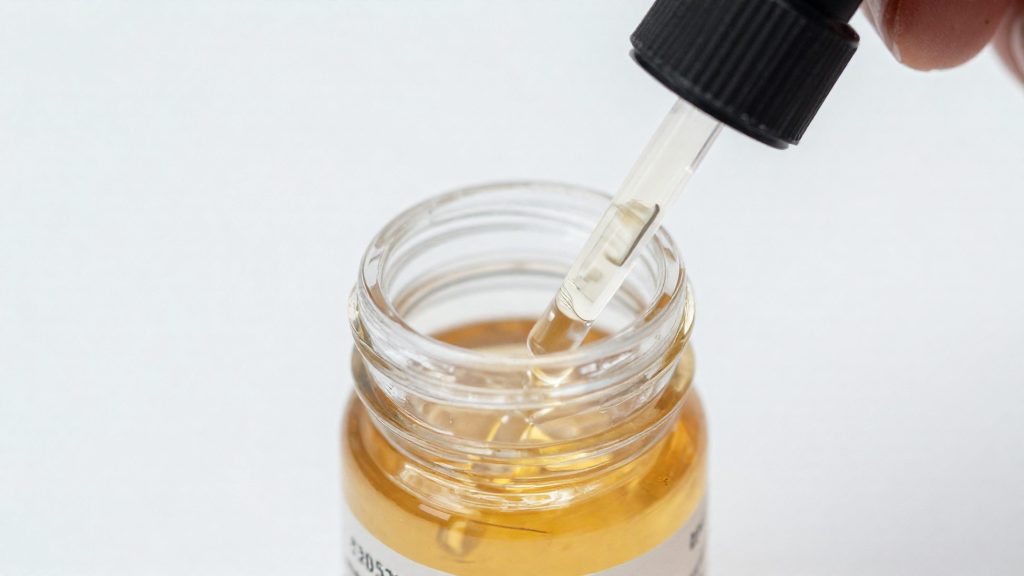
If the resin does not list a wavelength, Formlabs suggests a laser pointer droplet test. Place a small droplet of the resin on a flat surface, then expose it to a 405 nm laser pointer. Compare the outcome against the two results below.
Interpreting a cured versus uncured droplet
- Droplet does not cure: according to Formlabs (2026), the resin is unlikely to work on a 405 nm printer.
- Droplet cures: the resin is fairly likely to be printable. Formlabs notes that print quality, reliability and speed still need evaluation.
A cured droplet shows that the resin reacts to 405 nm light. It does not show that the resin will produce good prints, so treat it as a first screening step rather than a final verdict.
Checking the printer side
Confirm the wavelength on the printer as well as the resin. On a printer with fixed output, the resin’s stated wavelength must match the printer’s light source. On an adjustable printer, check the wavelength options in the printer settings before loading the resin.
Does wavelength affect resin color?
Wavelength is linked to color, but the formula matters too. According to Liqcreate (2026), 405 nm resins are typically much less yellow than daylight resins, and this comes from the color of the blockers and initiators in the resin. Two resins built for the same wavelength can therefore look different after curing, because their components differ.
385 nm resins follow a different pattern. Liqcreate describes them as often reactive up to about 400 nm and often designed for 385 nm. The same source says 385 nm resins can give a clear, non-yellowing result if they are developed properly. Clarity is a possible benefit of 385 nm resins, but on a 405 nm printer they can be hard to print, so confirm compatibility with the printer before choosing one for that reason.
| Property | 405 nm resin | 385 nm resin |
|---|---|---|
| Typical color after curing | Much less yellow than daylight resins | Can be clear and non-yellowing when developed properly |
| Color driver named in the source | Blockers and initiators | Not specified beyond the resin’s components |
| Typical design wavelength | 405 nm | Often 385 nm |
Because the color behavior depends on the resin’s components, compare the product data of each resin before assuming a difference in yellowing or clarity. Check whether the manufacturer names the blockers and initiators, and whether the resin is described as designed for 385 nm or 405 nm.
Common problems with mismatched resin wavelength
Resin printers harden each layer with UV light, and the wavelength a resin is formulated for determines whether it reacts with the printer’s light source. When a resin is not designed for 405 nm, the defects range from partial curing to a complete failure.
Undercuring
A resin not designed for 405 nm may undercure, meaning it does not fully harden under the light the printer delivers (Formlabs, 2026). Undercuring is one possible mismatch outcome, and it can occur even when the print appears to finish. Consult the resin manufacturer’s guidance before printing to check for any exposure adjustments.
Increased Z bleed
A mismatched resin may also show increased Z bleed, which is extra solidification between layers in the vertical direction (Formlabs, 2026).
Complete failure to cure
A resin not designed for 405 nm may not cure at all (Formlabs, 2026), in which case the print fails. A resin should therefore be treated as incompatible until its wavelength is confirmed as 405 nm.
Frequently asked questions
Can one printer handle both 385 nm and 405 nm resins?
Some can. Shining 3D says its L4D works with both 385 nm and 405 nm resins through an adjustable LCD screen, and users switch the wavelength by changing printer settings. Check the manufacturer’s documentation for your model before assuming it supports both.
What should I do if a resin doesn’t state its wavelength?
Formlabs suggests placing a droplet of the resin under a laser pointer test with a 405 nm laser. If the droplet does not cure, the resin is unlikely to work on your printer. If it does cure, it is fairly likely to print, but quality, reliability and speed still need evaluation. Wear eye protection when using a laser and gloves when handling uncured resin.
Why are 405 nm resins often less yellow than daylight resins?
Liqcreate says 405 nm resins are typically much less yellow than daylight resins, because of the color of their blockers and initiators. Yellowing therefore depends on the formulation of the resin, not on the wavelength alone.