No single enclosure filter is established as the best for every printer. The filter media determines what it can capture: HEPA media targets particles, while activated carbon targets gases. According to CDC/NIOSH (2023), particle control near printers can use HEPA-filtered local exhaust, and gas and vapor filters should be added when VOCs are a concern.
Comparing Filter Media for Printer Enclosures
Named enclosure filter models
The AlveoONE is the named enclosure filter covered here. Check its product label or the manufacturer’s instructions for the exact media it contains before comparing it with other models, because a product name alone does not show whether it uses HEPA media, activated carbon, or both.
Media types compared
| Media or rating | What it targets | Limit stated in the sources |
|---|---|---|
| HEPA media | Particles, including those from heated feedstocks | Media efficiency does not establish the removal performance of a whole enclosure installation |
| Activated carbon | Gases, through a gas-removal filter (EPA, 2018) | — |
Fit within the enclosure setup
Filtration supplements source control and ventilation. According to the U.S. Environmental Protection Agency (2026), portable air cleaners cannot remove every indoor air pollutant, so the enclosure filter works alongside the enclosure itself rather than replacing it.
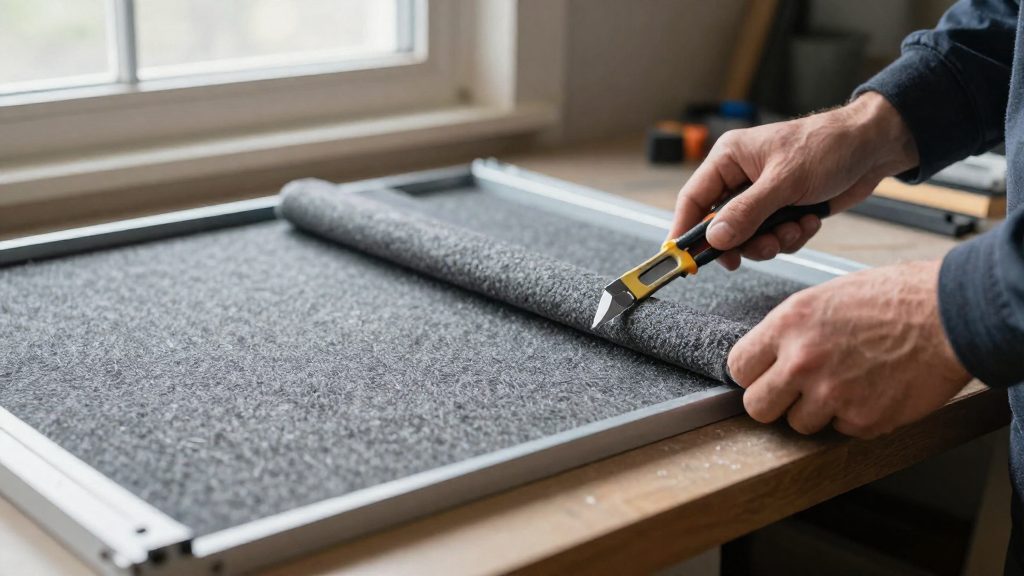
Do You Need HEPA and Carbon?
Whether an enclosure needs a HEPA filter, an activated carbon filter, or both depends on what the printer releases. According to CDC/NIOSH (2023), heated 3D-printing feedstocks can emit ultrafine particles and volatile organic compounds (VOCs), and the emissions vary with material, color, temperature and other printing conditions. Particle capture and gas removal are therefore separate decisions, and each one follows its own emission type.
When HEPA Filtration Is Needed
HEPA filtration targets particles. For particle control near printers, NIOSH recommends considering HEPA-filtered local exhaust (CDC/NIOSH, 2023). Ultrafine particles are the main emission type that a HEPA stage addresses, so a HEPA filter is the starting point for any printer that releases particles.
A HEPA filter’s media efficiency does not establish the particle removal performance of a complete enclosure installation. Air leakage, filter loading and airflow routing all affect the result.
When Activated Carbon Is Needed
Activated carbon handles gases and vapors. EPA recommends activated carbon or another gas-removal filter for gases, and notes that activated carbon can be effective when the filter contains a large amount of material (U.S. Environmental Protection Agency, 2018). A thin carbon layer therefore offers limited adsorption capacity.
NIOSH recommends adding gas and vapor filters when VOCs are a concern (CDC/NIOSH, 2023). NIOSH states that gas and vapor filters should be added when VOCs are a concern (CDC/NIOSH, 2023). Because VOC output depends on the feedstock and temperature, the decision should be based on the material being printed rather than on a fixed rule.
When Gas Filters Are Added to Particle Filters
A combined setup places a particle filter and a gas-removal filter in the same airflow path. The particle stage captures ultrafine particles first, and the carbon stage then adsorbs gases.
Enclosure Filters Versus Room Air Purifiers
An enclosure filter works at the source: it captures emissions where the printer produces them, before they spread into the room. A whole-room portable air cleaner treats the air of the entire space, so it dilutes and filters pollutants that have already escaped. The two approaches solve different parts of the problem, and neither replaces the other.
What CADR Measures and What It Does Not
The Clean Air Delivery Rate (CADR) is the usual performance figure for portable air cleaners, but it describes particle cleaning only. According to the U.S. Environmental Protection Agency (2018), CADR measures particle cleaning performance, not gas removal. The same EPA source notes that no widely used performance rating system exists for portable air cleaners that remove gases.
This matters for 3D printing because heated feedstocks can emit both ultrafine particles and volatile organic compounds (VOCs). A high CADR figure therefore says nothing about how well a cleaner removes VOCs from a resin or filament print.
Why Source Control Comes First
According to CDC/NIOSH (2023), ventilated enclosures and local exhaust are source controls that are more efficient than general dilution ventilation. A room purifier filters pollutants from room air after they escape the printer; general dilution ventilation reduces concentrations by introducing cleaner air.
Should You Exhaust Air Outdoors?
Venting enclosure air outdoors and filtering it back into the room are two different ways to handle the same emissions. Which one is appropriate depends on whether the enclosure’s air flow has been evaluated. According to CDC/NIOSH (2023), air from a custom printer enclosure may be filtered and recirculated only if the control has been evaluated to ensure contaminants are not released back into the room.
Local Exhaust as a Source Control
NIOSH identifies source control through ventilated enclosures and local exhaust as more efficient than general dilution ventilation. The reason is that the enclosure captures emissions where they are produced, instead of diluting them across the whole room.
Formlabs recommends at least three full air exchanges per hour for rooms using its SLA products, and advises against operating them in unventilated closets or small storage rooms. This figure applies to Formlabs’ ecosystem. NIOSH cites research finding three air changes per hour insufficient for ultrafine emissions during regular or prolonged desktop printing, so it is not a universal home-printing threshold.
Filtered Recirculation After Evaluation
Recirculation is the option that keeps air in the room, so it carries the main risk. Recirculation should therefore be treated as a conditional choice, not a default.
The NIOSH discussion of enclosure clearance cites an approximately 20-minute clearance time from one particular FFF study. That figure is not established as sufficient for every enclosure or resin workflow, so it should not be used as a general rule.
Duct Routing Through a Window or Wall
When exhaust is sent outdoors, the duct outlet must lead the air completely out of the room. Run the duct through a window or wall opening, and seal the gaps around it so that exhaust does not leak back inside. Keep the outlet away from any fresh-air intake or open window that could draw the exhaust back into the building.
Use a duct run that is as short and direct as practical, and check it after installation by confirming the exhaust is not returning into the room. The guidance does not give duct diameters or flow rates, so follow the enclosure or printer manufacturer’s instructions for those values.
Choosing Filters for FDM and Resin
The right filter depends on what the printer releases. Both FDM and resin printers can emit particles and organic vapors, so filter selection should address the emissions of the specific printer, material and workflow.
FDM feedstock emissions
Emissions are not constant across spools. The same source notes that the output changes with the material and its color, so a filter sized for one filament may be under-specified for another. Check the printing conditions you use most often, not a single reference spool, before settling on a filter setup.
Heating temperature effects on FDM emissions
Nozzle and bed temperature are part of the emission conditions NIOSH lists alongside material and color. Running hotter or printing for longer can therefore change what the filter has to handle, which is a reason to keep print profiles stable when you rely on a particular filter.
Resin printer volatile organic compound exposure
Resin printing can release both particles and organic vapors, so gas removal should be considered alongside particle control.
Matching the filter to the emission
- FDM filament: prioritize particle capture.
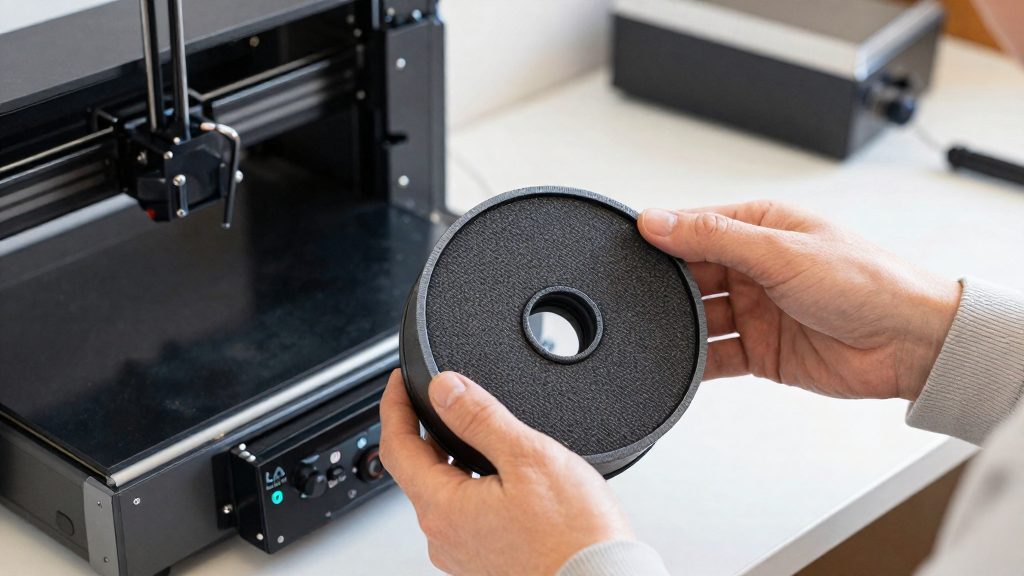
Airflow, Fit, Noise, and Replacement Costs
Filtration on a printer enclosure adds resistance to the airflow the enclosure fan has to push.
Airflow loss and noise
Every filter medium restricts airflow. A fan that moves air through a dense HEPA or activated carbon layer works harder, which can reduce the volume of air exchanged and raise fan noise. A clogged filter increases resistance over time, so the airflow you measured with a clean filter will drop as it loads.
- Check fan operation with the filter installed and again after each replacement.
- Compare the enclosure’s internal airflow with the filter removed and installed, using the same fan speed.
- If fan noise or enclosure temperature changes, inspect the system and check airflow before attributing the change to filter restriction.
Filter fit and sizing
A filter only controls emissions if air passes through it rather than around it. Record the width, height and depth of every vent, then confirm that the filter frame covers the full opening with no gap at the edges. A loose seal lets unfiltered air bypass the media.
Recurring replacement costs
Because replacement is driven by loading rather than a fixed schedule, track how often the filter needs changing in your own use and multiply that by the cost of a replacement set.
When Should You Replace Your Filters?
Enclosure filters do not last indefinitely, and the sources in this area give no fixed replacement interval. The EPA states that filters require regular replacement, and that dirty, overloaded filters do not work well (EPA, 2018). Follow the manufacturer’s replacement schedule and operating conditions, and investigate reduced airflow or other performance changes before continuing to rely on the filter.
Signs that a filter is overloaded
A loaded filter loses effectiveness, so watch for these conditions:
- Visible dust or residue on the outer surface of the media.
- Reduced airflow through the enclosure, which can show up as a weaker pull at the vent.
- A persistent printing odour after the filter has been in use for a long time.
These signs warrant checking the filter and airflow path against the manufacturer’s maintenance and replacement guidance.
Activated carbon saturation
Carbon holds a finite amount of material, so once its capacity is used up it no longer removes gases effectively. The sources do not give a saturation figure, so you cannot estimate it from print hours. Replace carbon media according to the manufacturer’s guidance for the operating conditions; investigate returning odors promptly, and do not use the absence of odor as evidence that gas removal remains effective.
Manufacturer replacement guidance
The most reliable replacement schedule comes from the filter’s own documentation. Check the product label and the manufacturer’s instructions for the replacement interval and the recommended operating conditions. If the label or instructions give no interval, contact the manufacturer directly rather than relying on a generic figure.