Printing ABS at home can release volatile organic compounds (VOCs) and ultrafine particles (UFP). The consulted evidence confirms that 3D printing in general produces both, but it does not measure ABS on its own, so it cannot say how much of a home exposure comes from ABS specifically. The official sources consulted do not specify the exposure level for a home hobbyist, so the risk depends on the setting, the printer and how close a person sits to it.
Is ABS fume exposure dangerous at home?
What the NIOSH study found
According to CDC/NIOSH (2025), published in the Journal of School Health, researchers examined 3D printer use in 11 university and K-12 school settings and detected both VOCs and UFP during printing. The study did not attribute these emissions to ABS, so its findings describe 3D printing as a whole. The authors recommend three layers of response: engineering controls, administrative controls and personal protective equipment (PPE).
Overall risk for a home hobbyist
The study covered shared school and university rooms, not single-user home workshops, so its results cannot be applied directly to a home setup. No occupational exposure limits specifically cover 3D printer emissions, which means there is no numeric threshold against which a home room can be checked.
The sources rank the available controls. Substitution with lower-emission materials, such as PLA instead of ABS, is described as the most effective. Particulate air filters, proper ventilation and user training follow as further controls, and PPE is the last resort.
Who is most exposed during printing sessions
The official sources consulted do not rank exposure by role, distance from the printer or age, so they do not identify which person in a household receives the highest dose. The only population the evidence describes is the one studied: students and staff using printers in shared classrooms and labs. A home operator who also works near the printer falls into the same general category of people sharing a room with emissions, but the evidence does not quantify the difference.
What the evidence does not establish
- Whether ABS emits more VOCs or UFP than other filaments. The NIOSH study did not attribute emissions to a specific material.
- Numeric exposure limits for 3D printer emissions, as no occupational limits specifically cover them.
- Exposure levels in home workshops, since the study examined school and university environments only.
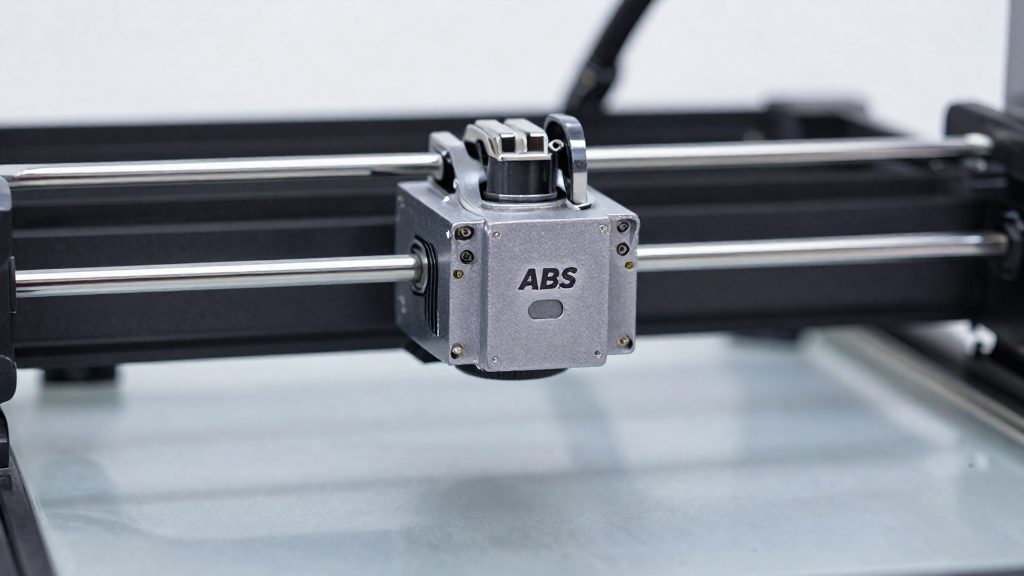
What ABS emits: VOCs and ultrafine particles
ABS is one of the most common home printing materials, and the open question is how much of the emission load it adds on top of printing in general. The most direct evidence is a NIOSH study of 3D printer use in 11 university and K-12 school settings. According to CDC/NIOSH (2025), it detected both volatile organic compounds (VOCs) and ultrafine particles (UFP) during 3D printing.
The study measured emissions during printing as a whole. It does not attribute the VOCs or UFP to ABS specifically, so it cannot tell you what share of the emissions comes from ABS compared with other filaments. The official sources consulted do not give particle counts or size data for ABS, so no emission figure can be quoted for this material.
Because the evidence does not isolate ABS, the practical question is which controls reduce exposure. The same CDC/NIOSH work, as summarized by Wikipedia (2026), ranks them as follows:
| Control | Role in reducing exposure |
|---|---|
| Substitution (e.g. PLA instead of ABS) | Described as the most effective control |
| Particulate air filters | Further engineering control |
| Proper ventilation | Further engineering control |
| User training | Further administrative control |
| PPE | Last resort |
No occupational exposure limits specifically cover 3D printer emissions, so the table is a ranking of controls rather than a set of compliance thresholds. For a home printer, the most actionable step is substitution: printing with a lower-emission material such as PLA where the part allows it, which the ranking places above filtration and ventilation.
Why ABS differs from PLA and PETG
The consulted sources name PLA as an example of a lower-emission material to use instead of ABS, which implies ABS is the higher-emission option. They give no emission measurements for ABS or PLA, so the size of the difference is unknown. According to CDC/NIOSH (2025), a study of 3D printer use in 11 university and K-12 school settings detected both volatile organic compounds (VOCs) and ultrafine particles (UFP) during printing. That study measured 3D printing in general and did not attribute the emissions to ABS specifically, so ABS-specific figures are not available from this source.
The official sources consulted describe substitution as the most effective control. Using a lower-emission material such as PLA instead of ABS ranks above particulate air filters, proper ventilation and user training, and PPE is the last resort. This is the only material-level comparison the sources make. They identify PLA as the lower-emission option but do not give emission measurements for PLA or for ABS, so the size of the difference cannot be quantified.
Data gaps remain for PETG. The official sources consulted contain no emission data for PETG, so its position relative to ABS and PLA cannot be confirmed from them. Users printing PETG should not assume it matches PLA’s profile without independent measurement.
The same sources state that no occupational exposure limits specifically cover 3D printer emissions. As a result, there is no regulatory threshold that separates ABS from PLA or PETG in these documents. The comparison rests on the substitution guidance and the absence of material-specific data, not on a numerical limit.
Do enclosures alone make ABS safe?
Enclosures are often presented as the fix for ABS fumes, but the official sources treat a closed cabinet as one control among several. A CDC/NIOSH study of 3D printer use in 11 university and K-12 school settings detected both volatile organic compounds (VOCs) and ultrafine particles (UFP) during printing (CDC/NIOSH, Journal of School Health, 2025). The study covered 3D printing in general and did not attribute the emissions to ABS, so it cannot show how much a given enclosure reduces exposure.
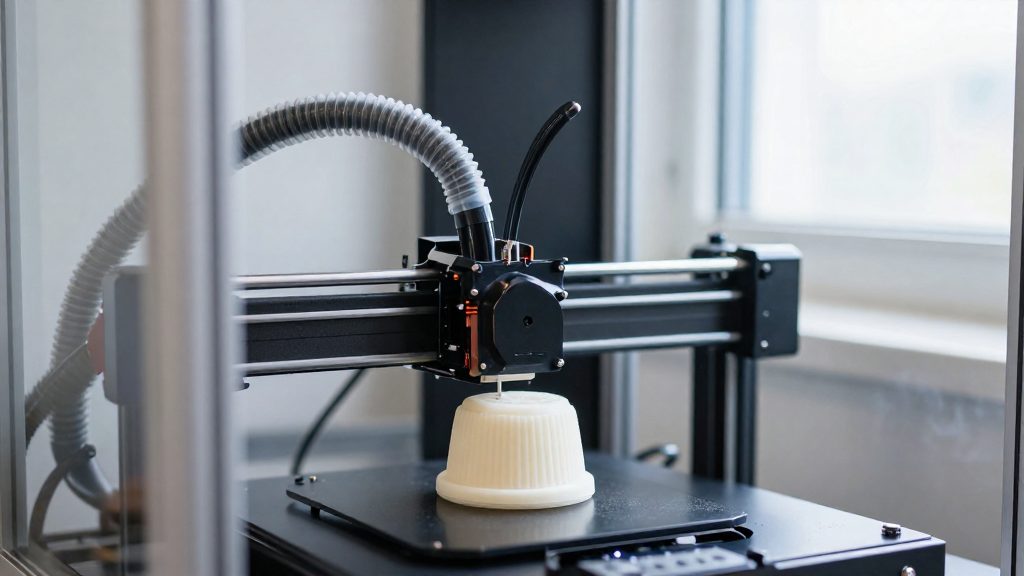
The authors recommend engineering controls, administrative controls and personal protective equipment (PPE). The sources name particulate air filters and proper ventilation as separate engineering controls. They do not assess enclosures, so whether an enclosure helps depends on whether its air is filtered or exhausted, which is a practical inference and not a finding.
Whether the enclosure contains emissions
The official sources consulted do not specify the containment performance of enclosures, so no reduction percentage can be given. What the study does establish is that emissions occur during printing itself. The practical question is therefore where the emitted air goes after it leaves the nozzle, and a closed cabinet changes that only if the air is routed through a filter or an exhaust.
Enclosures without exhaust or filtration
An enclosed printer with no ventilation or particulate filtration lacks the controls the sources list beyond the enclosure itself. Without them, the remaining layer is PPE, which the sources place last in the hierarchy. Check whether the enclosure has an exhaust path and a filter before relying on it for ABS.
Opening the enclosure door during prints
The sources do not address door openings specifically. Opening the door during a print releases the air inside the enclosure directly into the room, so limit openings to essential interventions such as clearing a jam or removing a finished part.
How to ventilate and filter a home print space
Ventilation and filtration reduce what a printer releases into a room, but they act on different things. A CDC/NIOSH study of 3D printer use in 11 university and K-12 school settings (2025) detected both volatile organic compounds (VOCs) and ultrafine particles (UFP) during printing. The authors recommend engineering controls, administrative controls and PPE. In a home print space, the engineering controls you can set up yourself are exhaust filtration on the printer and airflow through the room.
Particulate air filters on printer exhaust
A particulate air filter fitted to the printer’s exhaust captures airborne particles before they spread into the room. This addresses the ultrafine particle fraction. Make sure the exhaust passes through the filter media rather than around it, and keep the filter housing sealed, because air that bypasses the media carries particles straight out.
Why particulate filters do not capture gases
A particulate filter traps solid particles and droplets. VOCs are gas-phase molecules, so they pass through particulate-only media. A filter rated for particles therefore does not remove VOCs, even though the study detected both. The official sources consulted do not specify how gas-phase media perform on ABS emissions, so treat any gas-removal claim with caution.
Room-level ventilation as a control
Room-level ventilation dilutes emissions that escape the printer. Where possible, vent extracted air to the outdoors, because a fan that recirculates air within the room moves VOCs around without removing them. Use a window or an extraction fan that exhausts outside the room, and keep the room ventilated for the full duration of a print.
No occupational exposure limits specifically cover 3D printer emissions, so there is no numeric air-change target to size a fan against. Choose equipment by whether it removes particles, removes gases, and exhausts air outside the room.
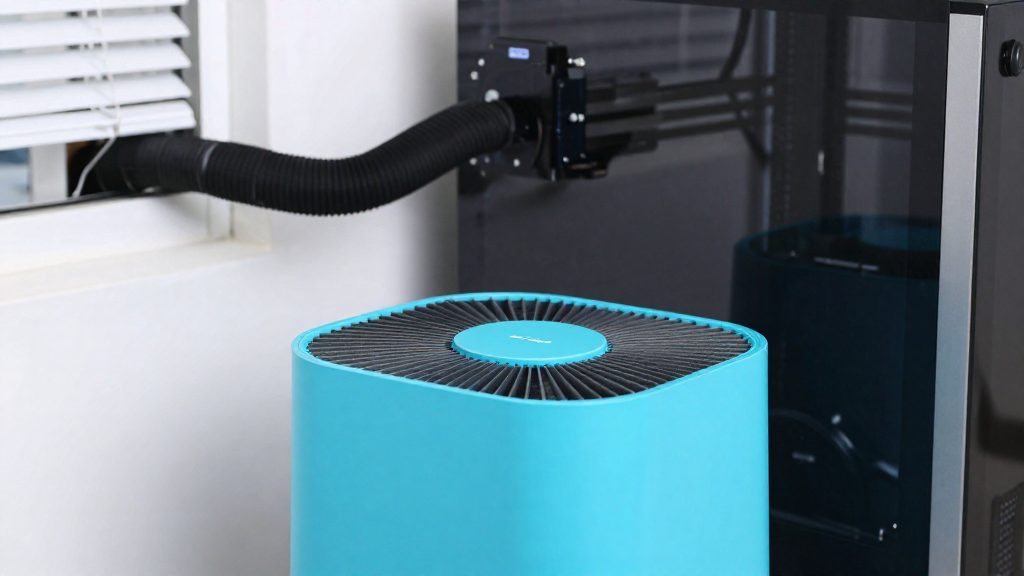
Which room is safest for printing ABS?
The official sources consulted do not specify a minimum room volume, a required distance from occupied areas or an air-change rate for ABS printing. The room choice therefore rests on how well the space can dilute and remove emissions. A CDC/NIOSH study in the Journal of School Health (2025) detected volatile organic compounds (VOCs) and ultrafine particles (UFP) during 3D printing across 11 university and K-12 school settings. The study did not attribute these emissions to ABS specifically, so the room guidance below applies to any filament.
Three room features matter most:
- Room volume and airflow: A larger room dilutes emissions more than a small one, but volume alone is not a control. The study’s recommended measures are engineering controls, administrative controls and PPE, so pick a room where ventilation can actually be applied, such as one with a window that opens or an exhaust point.
- Distance from occupied areas: Place the printer as far as practical from living and sleeping areas. No distance figure is given in the sources.
- Shared HVAC air recirculation: If the room’s air returns through a system that also serves other rooms, emissions can reach those rooms. Check whether the room’s air is recirculated and where it goes before choosing a location.
Substitution is the stronger control. The sources describe switching to a lower-emission material, such as PLA instead of ABS, as the most effective measure. Room selection reduces exposure only after the material choice has been made.
Should you switch to a lower-emission filament?
Substitution is the control the sources rank first. According to a summary of CDC/NIOSH guidance (2026), replacing a high-emission material with a lower-emission one, such as PLA instead of ABS, is the most effective control. Particulate air filters, proper ventilation and user training come next, and PPE is the last resort. No occupational exposure limits specifically cover 3D printer emissions, so there is no regulatory threshold to check a switch against.
A NIOSH study of 3D printer use in 11 university and K-12 school settings (CDC/NIOSH, 2025) detected both VOCs and ultrafine particles during printing. It did not attribute these emissions to ABS specifically, so the study does not show how much a switch would reduce exposure.
When switching is the first step
Switch first when the part does not depend on ABS’s specific properties. Before changing the setup, do the following:
- List the conditions the finished part must withstand, such as heat exposure or mechanical load.
- Check whether the replacement material can meet each of those conditions, using the manufacturer’s datasheet for that filament.
- If it can, change the material before adding filtration or changing ventilation.
ABS applications that are hard to replace
The sources consulted do not give temperature or strength figures for ABS or PLA, so the comparison has to come from the datasheets. Parts that must tolerate higher temperatures or carry sustained mechanical loads are the cases where a switch may not be viable. In those cases, the remaining controls become the main measures.
Practical limits of switching
- Substitution changes the material only. The sources list filters, ventilation and training as further controls, so substitution is one layer of protection, not a complete one.
- If a replacement fails the part’s heat or load requirements, the print will not meet its purpose, so keep ABS for those parts and apply the other controls to them.
What do the NIOSH sources say about 3D printer emissions?
The main official reference is a CDC/NIOSH study of 3D printer use in 11 university and K-12 school settings, published in the Journal of School Health 95(4) on 2025-04-01. The study detected both volatile organic compounds (VOCs) and ultrafine particles (UFP) during 3D printing in general. It did not attribute these emissions to ABS specifically, so its findings describe printing as a whole rather than one filament type. Because the study covered school environments, it does not measure home rooms.
The authors recommend three layers of control: engineering controls, administrative controls and personal protective equipment (PPE). A Wikipedia summary of NIOSH/CDC guidance (2026) ranks these measures, as shown below.
| Control | Position in the sources |
|---|---|
| Substitution, such as PLA instead of ABS | Described as the most effective control |
| Engineering and administrative controls | Recommended by the NIOSH study authors |
| Particulate air filters, proper ventilation and user training | Further controls |
| Personal protective equipment | Last resort |
No printer-specific exposure limits
The same summary states that no occupational exposure limits specifically cover 3D printer emissions. There is therefore no published numeric threshold against which a printer’s output can be checked. Your control decisions have to rest on the ranking above rather than on a measured limit.
Canadian guidance
The official sources consulted do not include Canadian guidance on printer emissions, so this section cannot report a Canadian position on home or workplace printing.
Where PPE fits
PPE is positioned as the final layer. The sources place it after engineering and administrative controls, filtration, ventilation and training. Respirators and similar equipment are therefore a backup for situations where those measures cannot reduce exposure enough, not a substitute for them.
Frequently asked questions
Is PLA a safer choice than ABS for printing at home?
The sources consulted name substitution with a lower-emission material such as PLA as the most effective control. They give no emission measurements for either material, so the size of the difference between them is unknown.
Does opening a window count as proper ventilation?
The sources consulted recommend proper ventilation but do not define it, and they give no airflow rates or room-volume figures. Whether a window setup is adequate for your room is therefore not something the sources can confirm.
Does an enclosure reduce ABS fumes?
The sources do not assess enclosures. Whether one helps likely depends on whether its exhaust air passes through particulate air filters, which the sources do name as a separate control, so an enclosure that vents unfiltered air into the room would offer less protection.