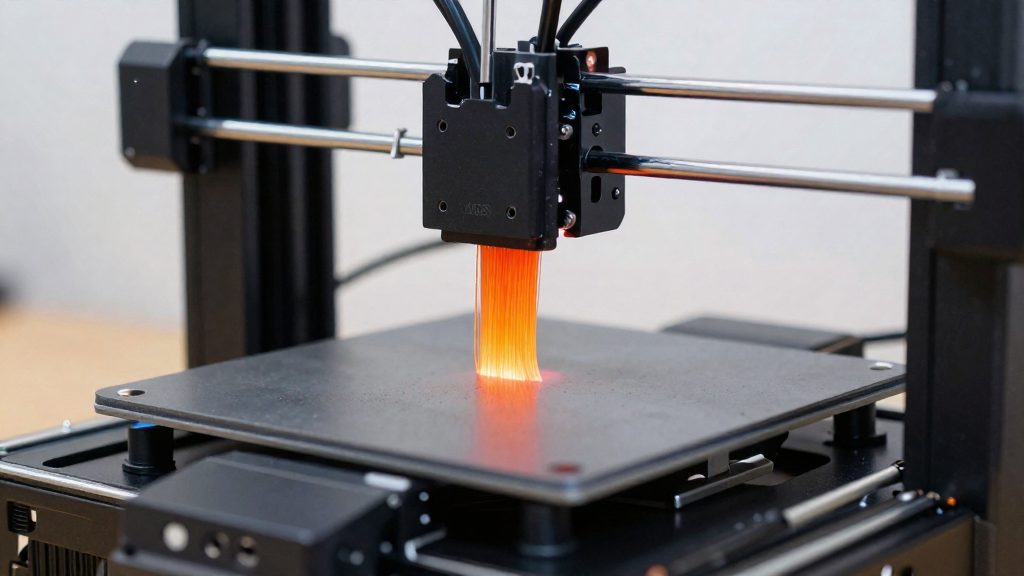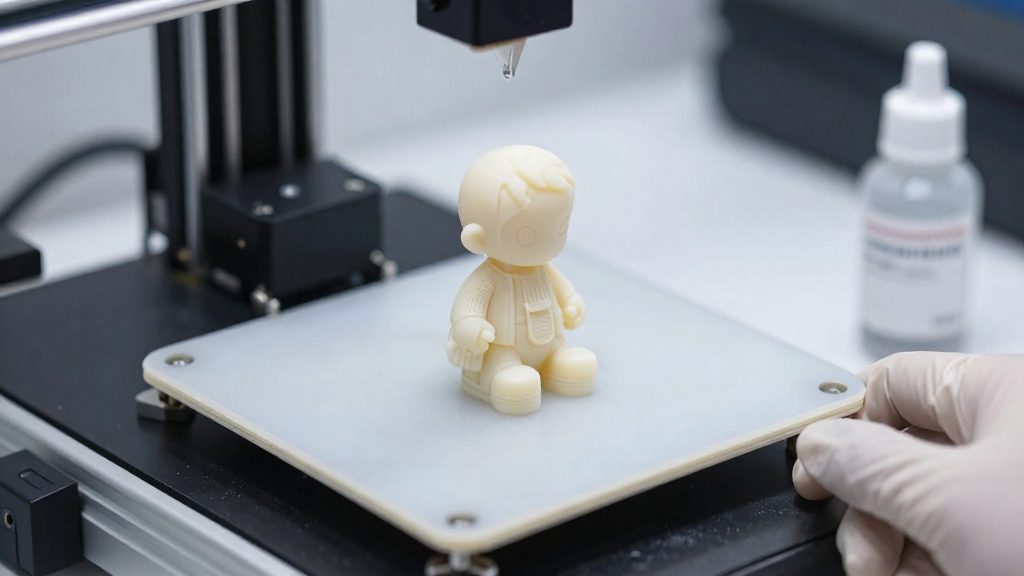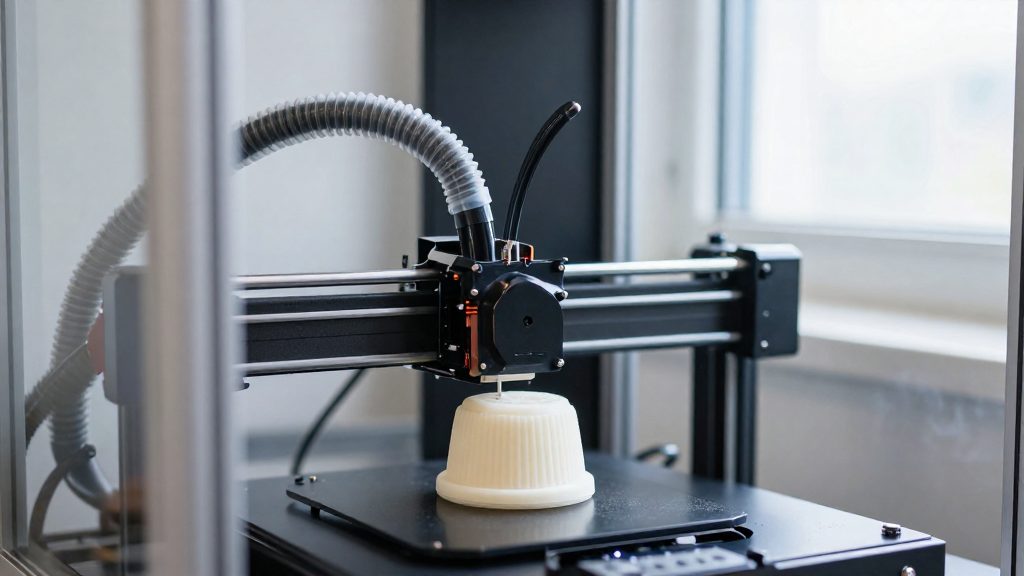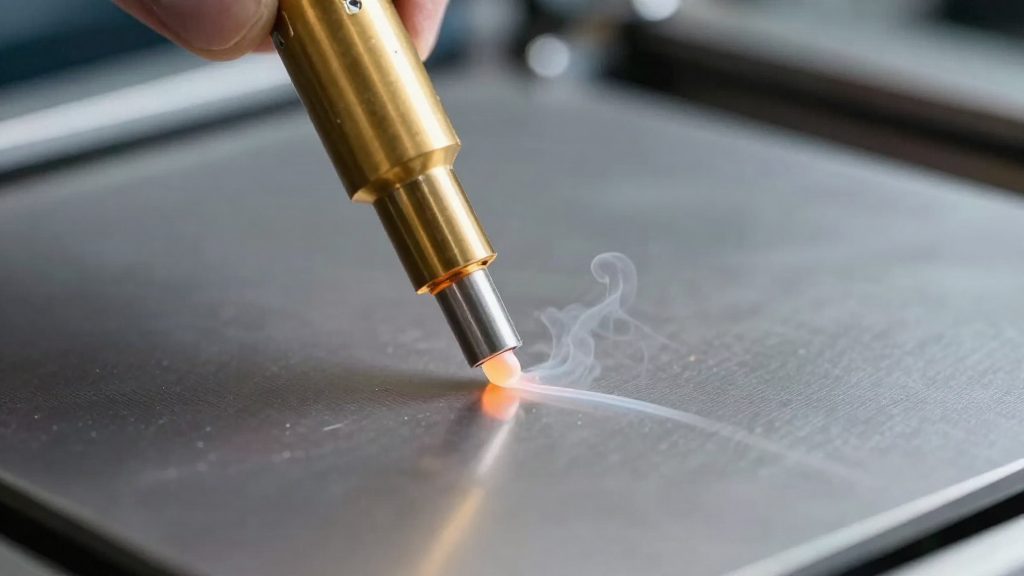
Desktop 3D printers emit ultrafine particles because the printing process heats plastic until it melts. According to the American Lung Association, printers create particles smaller than 0.1 micron (100 nanometers) when plastic filaments heat and melt. These particles are small enough to stay in the air of the room where the printer runs. How much is released depends on the filament, the printer type, the temperature and the ventilation.
Why do 3D printers emit ultrafine particles?
Heating and melting create the particles
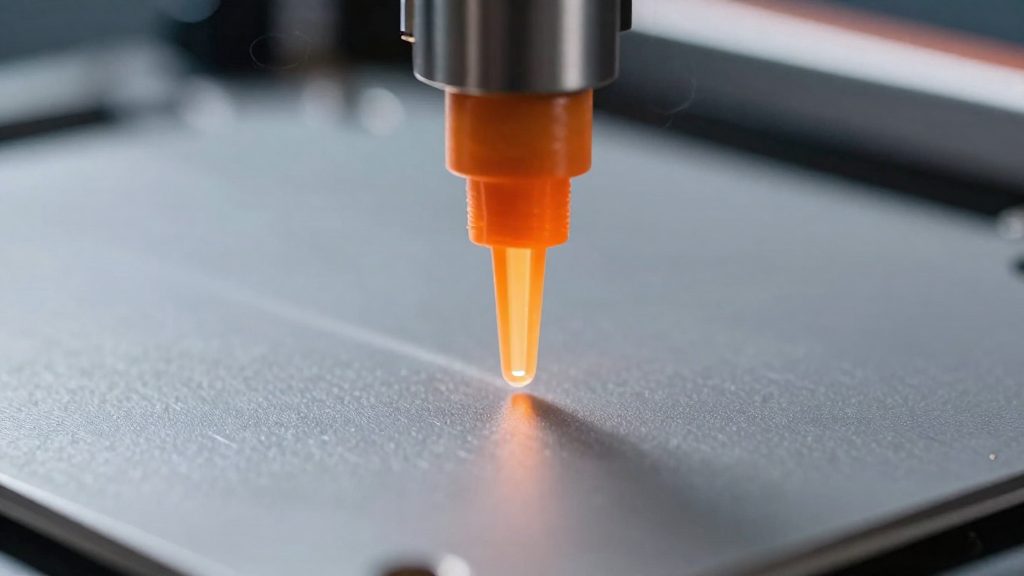
Filament is fed into a heated nozzle, where it softens and melts before being extruded. For filament (FFF/FDM) printers, the heating-and-melting stage is the source of the particles named by the American Lung Association. The sources consulted do not explain the mechanism for resin printers, which also showed high particle counts in the pilot study. Because this happens at every layer of a print, emission continues for as long as the printer is heating and extruding material.
Why the particles stay in indoor air
Ultrafine particles are suspended in indoor air for long periods, so they do not settle quickly after a print finishes. The exposure risk therefore depends on how long the particles remain in the room, not only on how long the printer runs.
Factors that drive emission levels
Four variables determine how much is released:
- Filament: the material being melted changes the emission level.
- Printer type: different printer designs produce different levels.
- Temperature: the operating temperature affects the amount released.
- Ventilation: the air exchange in the room affects the concentration that builds up.
The official sources consulted do not specify the direction or size of the effect of each factor, so this section gives no per-factor figures. Treat the four variables as the levers that change exposure, and record your own setup when comparing printers.
What the measurements show
A pilot study by Felici et al., published in Frontiers in Public Health in 2023, measured particle counts from one resin printer and one filament printer in research laboratories (an occupational setting, not a home). It recorded two values: the personal exposure of the operator at the printer, and the environmental concentration measured in the room.
Operator exposure: resin versus filament
| Printer | Technology | Material | Mean personal exposure | Mean particle size |
|---|---|---|---|---|
| Formlabs Form 2 | SLA (resin) | Resin | about 4,091 particles/cm³ | about 48 nm |
| Ultimaker S5 | FFF (filament) | PLA | about 2,203 particles/cm³ | about 60 nm |
The resin printer recorded nearly twice the personal count of the filament printer. The filament printer’s particles were slightly larger on average. Both values come from a single pilot study, so they describe these two machines under the study’s conditions, not printer types in general.
Room concentrations against the WHO reference
- SLA (Formlabs Form 2): mean environmental concentration of about 11,806 particles/cm³, with a maximum of 59,152 particles/cm³. The mean exceeded the WHO-referenced 24-hour level.
- FFF (Ultimaker S5): mean environmental concentration of about 5,414 particles/cm³. The mean stayed below the WHO-referenced 24-hour level.
The official sources consulted do not specify the numerical value of that 24-hour level. The WHO’s 2021 guidelines set no limit value for ultrafine particles, so the comparison is a referenced benchmark rather than a UFP-specific limit. The resin printer’s maximum reading shows that short-term peaks can be well above its average.
FDM filaments compared: ABS, PLA and others
Filament chemistry is one of the main factors that sets how much an FDM printer emits. ABS and PLA show clearly different profiles, and the gap between them is worth factoring into material choice.
ABS: higher styrene and particle output
ABS produces relatively high levels of styrene and ultrafine particles (UFPs). Styrene is a volatile organic compound (VOC), so ABS raises concern on two fronts at once: particles and vapours. When the goal is to limit emissions, ABS is the higher-emission option of the two materials compared here.
PLA: lower emission, but not zero
PLA is generally lower-emission than ABS, yet it still releases particles and VOCs. Lower does not mean absent.
Shared mechanism and data gaps
A CAREX Canada review summary (2021) states that a significant fraction of particles released during 3D printing could fall in the ultrafine range, and that increased levels of metals and VOCs could be detected during additive manufacturing.
The official sources consulted do not give emission figures for other FDM filaments, so this comparison covers only ABS and PLA.
Are resin printers safer or worse?
Resin printers are not clearly safer than filament printers for airborne emissions. According to the American Lung Association, resin printers can release VOCs (volatile organic compounds) and chemical vapours during printing, and again during UV curing of finished prints. The official sources consulted do not specify a direct ranking of resin against filament printers for VOC output.
Filament printers are not uniformly low-emission either. The American Lung Association describes the three cases below:
| Printer and material | Emissions named by the source |
|---|---|
| Resin (UV-cured) | VOCs and chemical vapours during printing and UV curing |
| FFF with ABS | Relatively high levels of styrene and ultrafine particles |
| FFF with PLA | Generally lower emission, but still particles and VOCs |
Because resin printers release VOCs and chemical vapours, the American Lung Association’s recommendation pairs activated carbon (for VOCs) with a HEPA air cleaner (for UFPs). The source does not quantify how much each measure reduces exposure.
Do ultrafine particles from 3D printing harm health?
According to the American Lung Association, ultrafine particles (UFPs) from 3D printers can be inhaled deep into the lungs and can also enter the bloodstream. According to the American Lung Association, these particles can be inhaled deep into the lungs and can also enter the bloodstream.
How the particles reach the body
- Inhalation: UFPs are breathed in with ordinary air and can reach deep into the lung tissue.
- Bloodstream: Once in the lungs, the particles can enter the bloodstream and travel through the body.
Filament differences
Choosing PLA reduces exposure compared with ABS; it does not remove it.
What is still unknown
The official sources consulted do not specify long-term health outcomes of breathing these particles over years of home printing. Short-term data on particle exposure from printers exist, but no source consulted links them to a specific long-term disease risk.
How to cut emissions at home
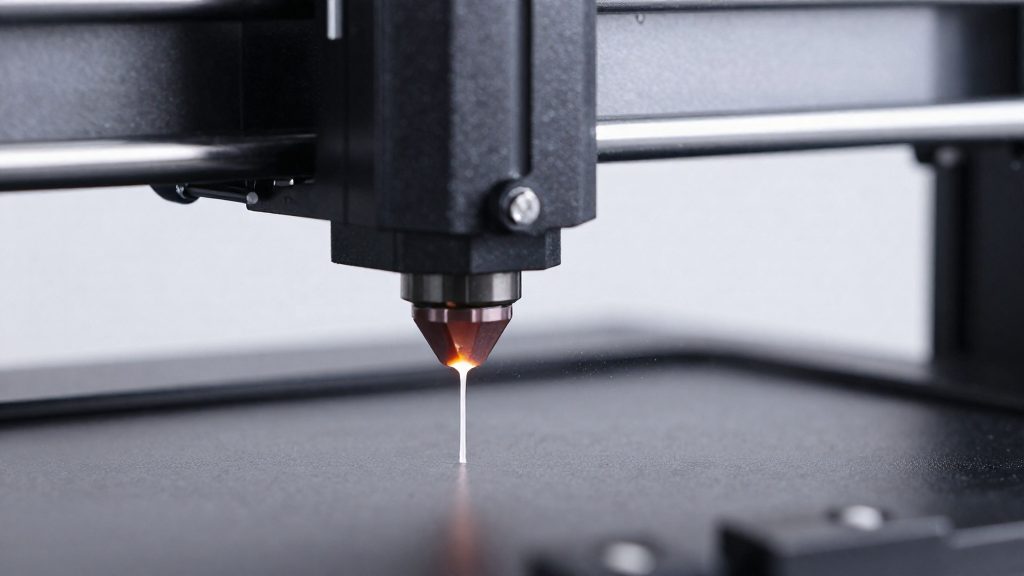
Three habits reduce how much of the emission reaches your living space: where the printer runs, when you handle the output, and which material you load. The American Lung Association recommends these precautions.
Print in a dedicated room with the door closed
Set up the printer in one room that you use only for printing, and keep the door shut while it runs. A closed door limits how far UFPs travel into bedrooms, kitchens, and living areas.
Wait at least 2 hours before handling prints or cleaning
Leave the room for at least 2 hours after a print finishes before you remove the part or clean the build plate and printer surfaces. Plan longer jobs so the wait falls outside your working hours, and do not start maintenance on a printer that has just completed a job.
Switch to lower-emission filament where practical
Choose PLA for projects where its properties suit the part, and reserve ABS for jobs that require it, printed under the room and waiting rules above.
Enclosures, HEPA and ventilation
According to the American Lung Association, the recommended approach combines several controls, because each one handles a different part of the emission. An enclosed printer limits emissions into the room, a HEPA air cleaner targets ultrafine particles (UFPs), activated carbon targets VOCs, and venting to the outdoors removes contaminated air from the room.
| Control | What it targets | Relevance from the source |
|---|---|---|
| Enclosed printer | Emissions released into the room | Recommended alongside lower-emission materials |
| HEPA air cleaner | Ultrafine particles | Particles are released by both ABS and PLA printing |
| Activated carbon | VOCs | Resin printers release VOCs during printing and UV curing |
| Outdoor venting | Contaminated room air | Emission levels depend on ventilation |
| Filter replacement | Continued performance of HEPA and carbon media | Filters should be replaced regularly |
The enclosure is the first point of control, since it keeps emissions from spreading through the room. The American Lung Association recommends enclosed printers alongside the other measures, not as a stand-alone control.
Place the HEPA air cleaner in the room where the printer runs, so it draws in the air that carries UFPs. For resin printers, activated carbon is the relevant filter. PLA also releases VOCs, so carbon media is useful with that material too.
Venting to the outdoors is listed as a separate precaution. It lowers the amount of emitted material that stays in the room, which complements a cleaner that recirculates indoor air.
The official sources consulted do not specify a filter replacement interval, so follow the replacement guidance provided by your cleaner’s manufacturer.
What Canadian readers should check
The official sources consulted do not specify Canadian indoor air guidance for ultrafine particles (UFPs) from desktop printers. The WHO 2021 guidelines set no UFP limit value, so there is no official threshold to test a room against. Canadian home users need to verify their setup against manufacturer documents and against the emission profile of each material they use.
| Verification item | What to check | What the sources report |
|---|---|---|
| Filament type | Material printed (ABS, PLA, other) | ABS: relatively high styrene and UFPs; PLA: generally lower, but still particles and VOCs |
| Resin printer | Resin safety data sheet from the vendor | VOCs and chemical vapours during printing and UV curing |
| Air filtration | Filter type matched to the pollutant | HEPA targets UFPs; activated carbon targets VOCs |
Before buying a filter, confirm that the model is sold through a Canadian retailer and that its specification sheet lists the pollutant it captures. The sources consulted do not establish which HEPA or activated carbon products are available in Canada.
Frequently asked questions
Is PLA safer to print with than ABS?
PLA is generally lower-emission than ABS, but it still releases particles and VOCs. ABS produces relatively high levels of styrene and ultrafine particles, according to the American Lung Association, so material choice is one of the main levers for reducing exposure.
Do the pilot study numbers describe a typical home workshop?
No. The pilot study by Felici et al. (Frontiers in Public Health, 2023) was carried out in research laboratories and measured occupational exposure, not domestic air. The official sources consulted do not give equivalent figures for home rooms.
Do resin printers release the same particles as filament printers?
The sources consulted do not explain the particle mechanism for resin printers, because the heating-and-melting process applies to filament printers. Resin printers can release VOCs and chemical vapours during printing and during UV curing, according to the American Lung Association.