Water-washable and standard resins differ mainly in what cleans the printed part. A water-washable resin is rinsed in water, while a standard resin typically needs isopropyl alcohol (IPA) or a similar solvent. According to Phrozen (2024), that difference changes the cleaning fluid you use, your exposure to fumes, and how you handle the rinse waste.
Washable vs standard resin: what actually differs?
How the water rinse works
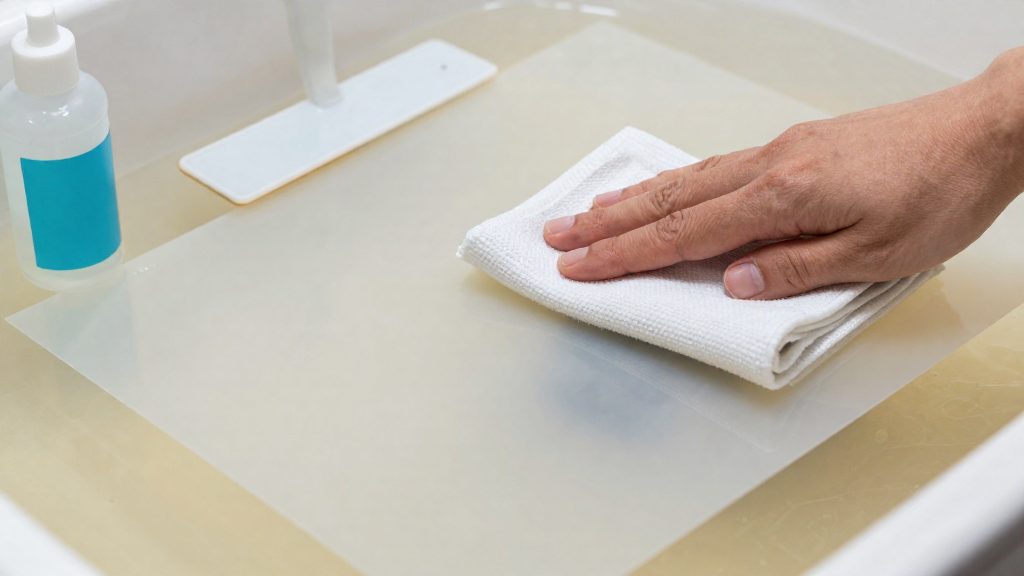
After printing, the part is covered in uncured resin, the liquid that has not hardened under UV light. A water-washable resin is designed to be rinsed off with plain water, so the workflow does not depend on a solvent. The rinse removes the uncured resin from the surface of the print and carries it into the wash water, which then has to be handled as chemical waste.
What the rinse removes and what it leaves behind
The rinse removes only uncured resin on the surface. It does not harden the part, so the print still needs its own curing step. The wash water is the main leftover: it still contains uncured resin even though the cleaning fluid is water.
Standard resin and its solvent requirement
A standard resin typically needs IPA or a similar solvent to remove uncured resin.
| Point | Water-washable resin | Standard resin |
|---|---|---|
| Cleaning fluid | Water | IPA or a similar solvent |
| Solvent use | Avoids flammable solvents | Requires solvent handling |
| Fume exposure | Reduced | Ventilation, gloves and protective equipment required |
Identifying the resin family from the bottle
Identify the resin from the manufacturer’s washing instructions. If those instructions name water as the rinse fluid, the bottle contains a water-washable resin. If they name IPA or a similar solvent, it is a standard resin.
Which resin gives better detail on miniatures?
Standard resin generally has a slight edge over water-washable resin in both accuracy and fine detail, according to Phrozen (2024-10-24). Treat this as a directional advantage rather than a measured specification. The features where this matters most on miniatures are small, sharp elements such as thin edges, engraved lines and tiny parts of a figure.
Accuracy and fine feature reproduction
Standard resin is the stronger starting point when a model depends on small features holding their shape. Water-washable resin is described as trailing slightly in both accuracy and fine detail, so the smallest parts of a miniature may come out slightly less sharp. If a figure has closely spaced or very small features, print it in standard resin first and compare the result against the water-washable version of the same model.
Surface detail and cleaning
For detailed parts, the rinse is where fine surface features are most at risk, because overcleaning water-washable prints can wash them away.
Is washable resin too brittle for tabletop minis?
Water-washable resin is generally described as more brittle than standard resin. Phrozen (2024-10-24) places it on the weaker side for brittleness. For minis, this trade-off matters most on thin, protruding features such as spear tips, wings and thin bases, which are more likely to chip or snap when a figure is knocked off a table or handled repeatedly.
Phrozen positions its Water-Washable Tough Resin as a fix for this weakness. The company says it is twice as tough as standard water-washable options. This is a manufacturer claim.
Because the toughness figure is unverified, the practical decision comes down to what the mini has to do:
- Display-only figures with fine detail: standard resin fits the brief.
- Figures that will be handled or played with: regular water-washable resin is described as more brittle than standard resin. The Tough variant is the one the manufacturer positions for durability, so test it on your own prints before relying on it.
- Thin, load-bearing features on any washable part: treat the claim as a starting point. Handle these parts carefully and avoid stacking or dropping them until you have seen how they hold up in your own use.
How do you wash and cure each type?
Washing and curing depend on the resin family. The steps below cover water-washable resin. For standard resin, follow the manufacturer’s instructions for your product.
Water-washable resin: wash and drying sequence
According to Inslogic3D (2024), the wash follows three steps:
- Primary wash: rinse the print in water for about 1–3 minutes.
- Second rinse: rinse again in clean water for 1–3 minutes.
- Drying: dry the part fully before curing. The sources do not give a drying duration, so confirm the surface is dry before moving on.
UV cure times
Fully dried parts go into a UV curing station. Cure time depends on part size:
| Part size | UV cure time |
|---|---|
| Small | 5–10 minutes |
| Large | 20–30 minutes |
The sources do not define where small ends and large begins, so classify each part by its actual dimensions and cure it for the matching range.
Is washable resin safer to use at home?
Water-washable resin reduces the chemical risks of home printing, but it does not remove the need for protective measures. According to Phrozen (2024), water-washable resin avoids flammable solvents and reduces chemical fume exposure, while standard resin still calls for ventilation, gloves and protective equipment. The main difference lies in the cleaning step: what liquid you use, and how much solvent and vapour you handle.
Because the solvent standard resin needs is flammable, a standard-resin workflow keeps a flammable liquid in the workspace for every wash. A water rinse removes that requirement.
| Factor | Water-washable resin | Standard resin |
|---|---|---|
| Cleaning liquid | Water | IPA or a similar solvent |
| Flammable solvent | Avoided | Used during cleaning |
| Chemical fume exposure | Reduced | Higher; ventilation required |
| Gloves and protective equipment | Gloves and a mask for handling wash water; check the SDS | Required |
Ventilation, gloves and protective gear for standard resin
For standard resin, the sources list three baseline measures: ventilation, gloves and protective equipment. Work in a space with airflow so fumes do not build up around the printer and the washing station. Wear gloves whenever you handle uncured resin, wet prints or washing liquid.
The Safety Data Sheet (SDS) for each product lists its specific hazards and is the reference for the exact protective equipment required. Read it before the first print, since the SDS of the specific product defines what gear is needed.
What water-washable resin changes
Water-washable resin lowers solvent handling and fume exposure, which makes the workflow simpler than a solvent-based one. Keep resin and wash water away from food-preparation areas and work in a ventilated space. It does not make the workflow risk-free. The sources still advise wearing gloves and a mask when handling wash water that contains uncured resin, and checking the product’s SDS.
How should you dispose of resin wash water?
Wash water from a water-washable resin print is not clean water. It still contains uncured resin, so it needs to be handled differently from tap water. According to Phrozen (2024), the method has two stages: leave the liquid in sunlight so the leftover resin hardens, then filter out the solids and discard them. Pouring the liquid down a drain is not part of this process.
Curing leftover resin in sunlight
Leave the wash water in sunlight for a few days. The sunlight cures the resin that remains suspended in the liquid, so it hardens instead of staying liquid. Use a container that can sit in the sun without leaking, and leave it there until the resin has fully cured.
Filtering solids before trash disposal
Once the resin has cured, filter the liquid to remove the hardened solids. Filtering separates the cured particles from the water, which leaves only solids to handle. Put those solids in the household trash, as the manufacturer advises. Rules on resin waste vary by municipality in Canada, so check with your local waste authority if unsure.
Why wash water must never enter drains
Water containing uncured resin must never be poured down the drain. Uncured resin is the hazard in this liquid, and a drain carries it directly into household plumbing. The curing and filtering steps above are the handling sequence for this liquid, so the drain is never the first option for disposal.
Which resin should you buy for your minis?
For miniatures, the choice between water-washable and standard resin depends on three things: how much fine detail you need, how tough the finished parts must be, and whether your workspace can handle solvent. Water-washable resin is described as more brittle, so it is the weaker option for parts that take handling and stress.
Detail versus toughness
The detail-versus-toughness trade-off is the main decision. If your priority is faces, hands and engraved textures, standard resin is the stronger default. If your priority is parts that must survive handling, note that water-washable resin is described as more brittle than standard resin. Only Phrozen’s Water-Washable Tough Resin is positioned for durability, and that is an unverified manufacturer claim.
Phrozen’s Water-Washable Tough Resin is the obvious candidate for the toughness side. Phrozen positions it as tougher than standard water-washable options, which is a manufacturer claim rather than independently verified performance. Treat it as an option to test on your own prints, not a guaranteed upgrade for every miniature.
Matching the choice to your washing setup
Your workspace often decides the resin before the print quality does. The two workflows differ as follows:
| Factor | Standard resin | Water-washable resin |
|---|---|---|
| Wash medium | Isopropyl alcohol (IPA) or a similar solvent | Water |
| Solvent | Flammable solvent required | Avoids flammable solvents |
| Fume exposure | Ventilation required | Reduced chemical fume exposure |
| Protection | Gloves and protective equipment | Gloves and a mask for handling wash water |
Choose standard resin if you have a ventilated area and can store and use solvent safely. Choose water-washable resin if you cannot keep flammable solvent in the room, or if you want to reduce fume exposure at your desk.
Frequently asked questions
Can I wash a water-washable print for too long?
Yes. According to Inslogic3D (2024), overcleaning can wash away fine details, so a typical wash lasts about 1–3 minutes, followed by a second rinse of 1–3 minutes. Dry the part fully before curing it.
Is Phrozen’s Water-Washable Tough Resin a better choice than ordinary water-washable resin?
It is tougher, but the source for that claim is the manufacturer. Phrozen says its Water-Washable Tough Resin is twice as tough as standard water-washable options, which addresses the brittleness of ordinary water-washable resins.
How do I dispose of leftover wash water?
Wash water still contains uncured resin, so it should not go down the drain. Phrozen (2024) recommends leaving it in sunlight for a few days so the resin cures, then filtering out the solids and discarding them in the trash. Wear gloves and a mask while handling it, and check the Safety Data Sheet (SDS).