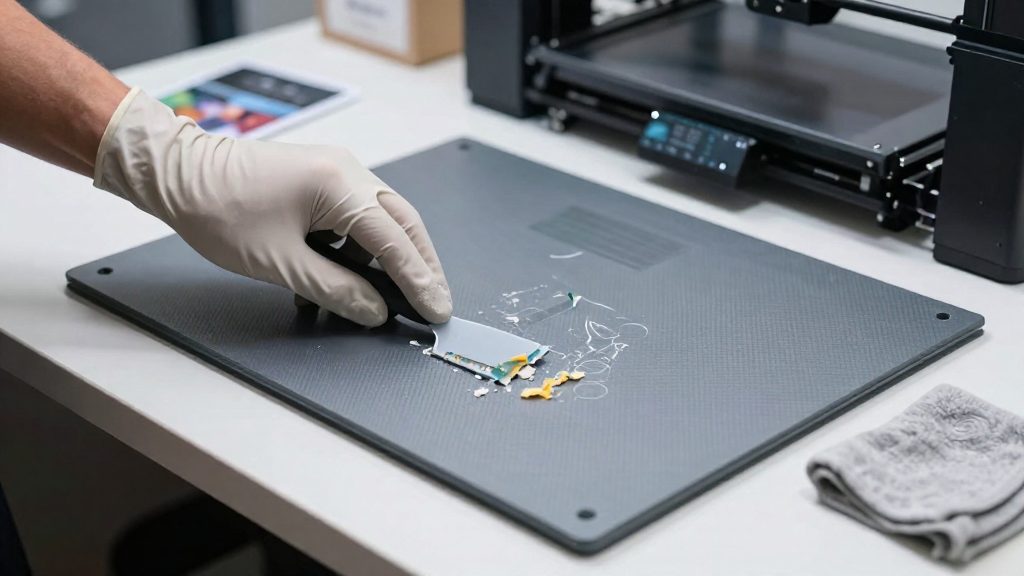
Remove glue stick residue with water first and use solvents only when the bed surface allows them. On PEI, a water-dampened paper towel softens the PVA buildup. On steel sheets, warm water with a few drops of dish soap works, and Prusa advises against fully submerging the sheet. On a PulseXE garolite bed, MatterHackers recommends a water-soaked paper towel over the glue with the bed heated to 40°C (104°F). Choose the method by surface type, and check the bed manufacturer’s instructions before using anything stronger.
How Do You Remove Glue Stick Residue?
Because the surface determines which products are safe, select the removal method by bed type, starting with water-based options.
Solvents as the last option
Solvents should only be used where the bed manufacturer permits them, since compatibility varies by surface and manufacturer. Isopropyl alcohol is recommended for degreasing the bed, but this does not show it removes PVA glue better than water.
No universal soak time, cleaning temperature or cleaning frequency applies to all beds, and no procedure is given here for resin-contaminated plates, so check the printer maker’s instructions for those cases.
Identify Your Print Bed Surface
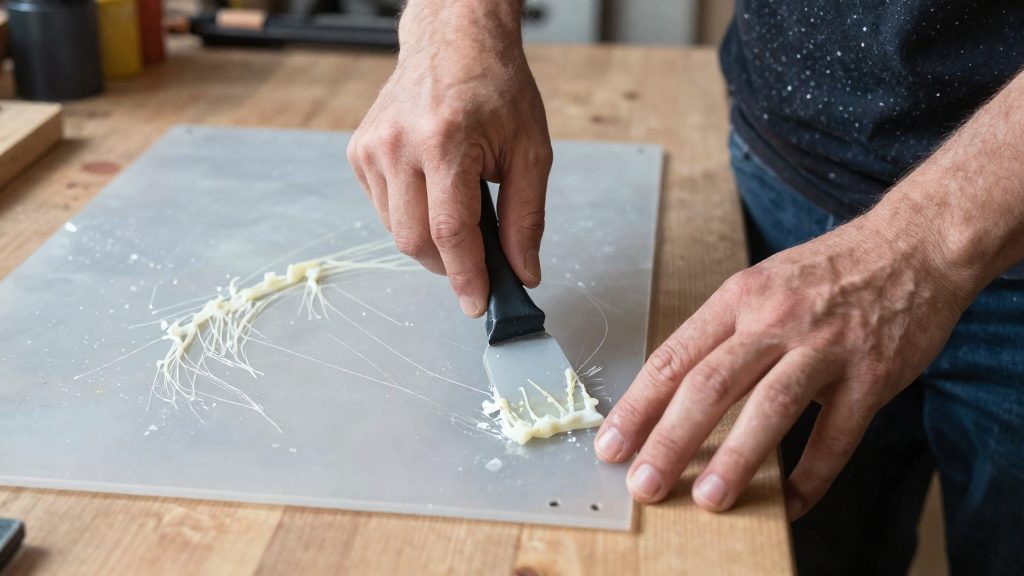
The coating on your print bed determines which cleaning methods are safe, because glue stick residue responds differently to water, dish soap, and solvents depending on what it sits on. Before you scrape, wipe, or soak anything, identify the surface. Prusa PEI sheets, the PVA-treated PulseXE garolite bed, and LulzBot PEI plates each have different documented cleaning points.
Prusa PEI Sheets (Textured, Satin, Smooth)
Prusa sells its PEI print sheets in textured, satin, and smooth variants. Follow Prusa’s maintenance instructions for the exact sheet finish. Prusa describes washing the textured sheet with warm water and a few drops of dish soap as an infrequent last resort because the sheet is not waterproof; do not infer identical water-cleaning requirements across all three finishes.
PulseXE Garolite Bed (PVA-Treated)
The PulseXE bed is a garolite surface treated with PVA glue. MatterHackers advises keeping this PVA layer from becoming too thick. A heavy buildup is harder to remove and can change first-layer adhesion, so clean the bed periodically rather than letting residue accumulate across many prints.
Because this bed uses a PVA treatment rather than a PEI coating, do not transfer PEI cleaning habits to it without checking the manufacturer’s guidance.
LulzBot PEI Plates
Other Plates and Unlisted Coatings
No single soaking time or cleaning frequency applies to every print bed, so follow the manufacturer’s instructions for your model. Bare glass plates and proprietary coated plates are not covered by any general method here. Check the product label or the manufacturer’s documentation for the coating type, then use only the method that the manufacturer specifies. If the documentation does not name the coating, contact the manufacturer’s support team before using a solvent.
Soften PVA Glue With Water
Glue stick residue on a PEI surface can often be loosened with water alone, without scrubbing the plate. According to LulzBot (2015), PVA buildup on a PEI print surface can be softened and removed with a paper towel moistened with water. The water softens the PVA buildup so it can be wiped away with a moistened paper towel.
Apply a Water-Soaked Paper Towel
- Soak a paper towel in water.
- Wring it out until it stops dripping. A dripping towel leaves standing water on the bed, which can reach the plate edges and the surrounding area.
- Lay the damp towel over the glue residue and leave it in contact until the PVA softens.
- Wipe the softened glue away with the towel, then dry the surface before the next print.
Heat the Bed Before Wiping Garolite Residue
On a garolite bed, the same damp-towel approach works better with heat. MatterHackers recommends placing a water-soaked paper towel, wrung out until it stops dripping, over the glue and heating the bed to 40°C (104°F) before wiping it away. This applies to the PulseXE garolite bed specifically; the source does not establish the same temperature for other beds.
Damp towel and gentle heat are the two levers here: the towel supplies the water that softens the PVA, and the warm bed speeds that softening so the residue wipes off with less pressure.
Clean With Dish Soap and Water
Prusa states that PVA glue can be wiped off its print sheets with dish soap and water. For its steel sheets, the company recommends warm rather than hot water with a few drops of dish soap. The water should be warm, not hot, and it should contain only a few drops of soap, so the mix stays mild.
Prusa advises against fully submerging its steel sheets in hot water. Keep the cleaning to a damp wipe over the glue residue, using a cloth or paper towel, and avoid soaking the whole plate.
The mild solution is the first step to try before harsher methods. Once the residue is lifted, rinse the surface and dry it fully before the next print.
Can You Use Alcohol or Acetone?
Whether acetone is safe to use on a glue-stick-coated bed depends entirely on the surface. Manufacturer guidance differs sharply between sheet types, so check the label or the manufacturer’s instructions before applying any solvent.
Prusa Sheets
Prusa’s rules split by surface finish:
| Surface | Acetone | Notes |
|---|---|---|
| Textured PEI | Prohibited | Prusa’s textured and satin sheets are not to be cleaned with acetone |
| Satin PEI | Prohibited | Same rule as the textured sheet |
| Smooth PEI | Occasional use only | Extended use makes the PEI brittle |
On the smooth PEI sheet, Prusa permits occasional acetone use to restore adhesion, but says not to use it before printing PETG. This permission does not establish acetone as a PVA glue-removal method. Repeated exposure is the main concern, because prolonged solvent contact makes the PEI layer brittle. Permission for the Prusa smooth PEI sheet should not be assumed for other PEI plates, since acetone compatibility varies by surface and manufacturer.
BuildTak on Pulse Models
MatterHackers warns that acetone ruins the BuildTak surface supplied on the relevant Pulse models. For those beds, avoid acetone entirely and remove glue residue with water-based methods instead.
Remove Stubborn Buildup Without Damaging Coatings
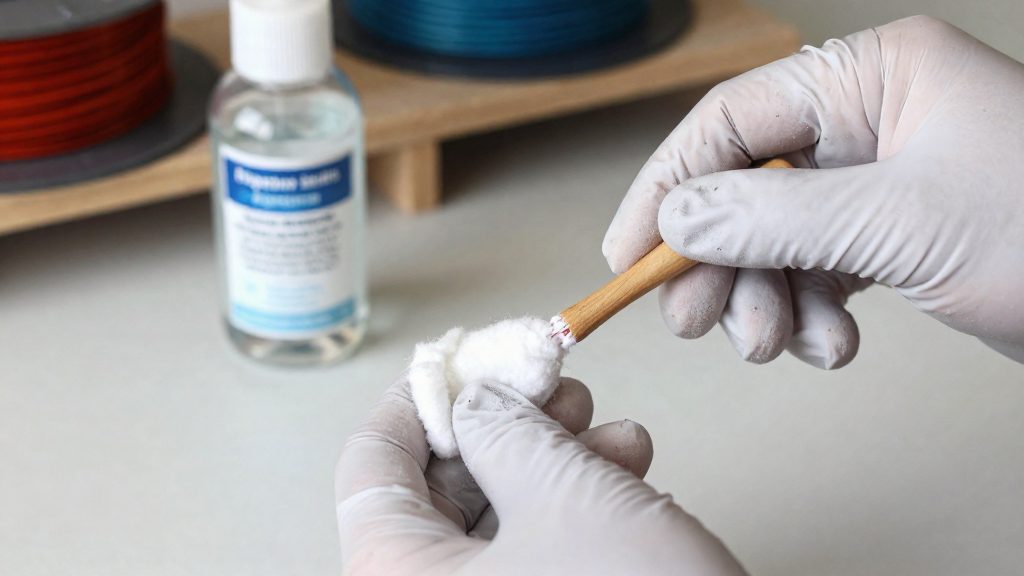
MatterHackers advises keeping the PVA layer on the PulseXE garolite bed from becoming too thick. Soften accumulated glue using the documented method for your surface, and avoid tools or solvents that could damage its coating.
Soften first, then wipe
Letting the water work on the film means less mechanical force is needed. Check the bed’s own manufacturer instructions before applying heat to any other surface.
Limit solvent exposure on smooth PEI
Use solvent sparingly, rinse and dry the surface afterwards, and do not treat a single permitted use as a routine cleaning step.
Avoid abrasive tools
MakerGear warns against tools that can scratch or damage its polyimide-coated print bed. Use a soft cloth or paper towel rather than a metal scraper on any coated surface, and stop scraping as soon as the film begins to lift.
Dry the Plate Before Printing
Complete drying after cleaning protects the bed before the next print. Residual water left on a steel or PEI surface can affect how the next layer bonds, so the drying step should be treated as part of the cleaning routine, not an optional extra.
For Prusa steel sheets, Prusa requires thorough drying before the sheet is used again. The sheet should be dried completely after any water-based wash.
Drying after any water-based cleaning is the general step that follows the method you used. Whether you cleaned with a damp paper towel, warm water with dish soap, or another water-based approach, wipe the surface dry and let it air out before loading the print.
When Should You Reapply Glue?
Removing glue stick residue does not mean the bed must stay bare. Prusa describes glue stick as both an adhesion aid and a protective separation layer, and states that removing it does not mean it should always be omitted from the next print. Whether to reapply depends on the material you print next and whether that print still needs the separation role.
Remove the PVA Treatment When Switching Back to ABS or PLA
When you move from a PVA-glued setup back to ABS or PLA, LulzBot recommends removing the PVA treatment to restore an even first layer (LulzBot, 2015-12-10). Clear the surface before the new material goes on, so that leftover film does not change how the first layer lays down.
- Inspect the bed for leftover PVA film before starting the new job.
- Remove the film and confirm the surface is clean before applying anything new.
- Reapply glue only if the next material and part need it.
Deciding Whether to Reapply
Reapply glue when the next print needs the adhesion or separation role. The guidance reviewed does not give a universal rule for which materials require it, so base the decision on the material’s behaviour on your bed and the printer maker’s recommendations.