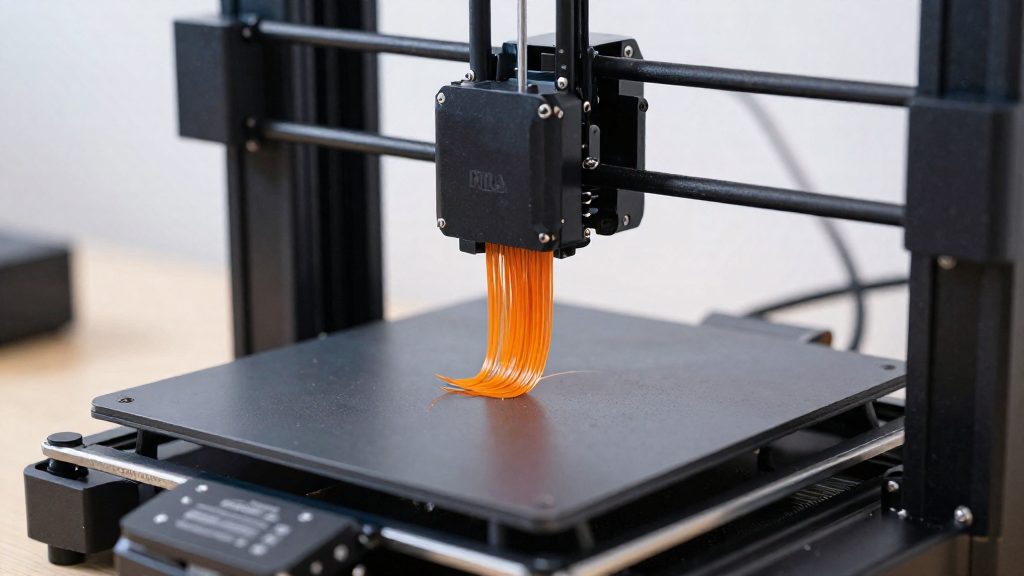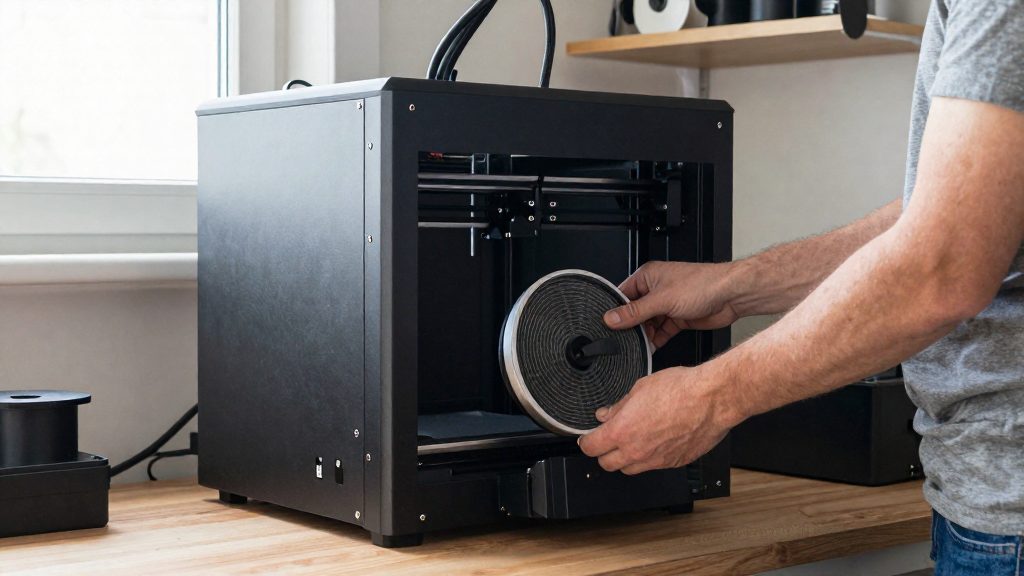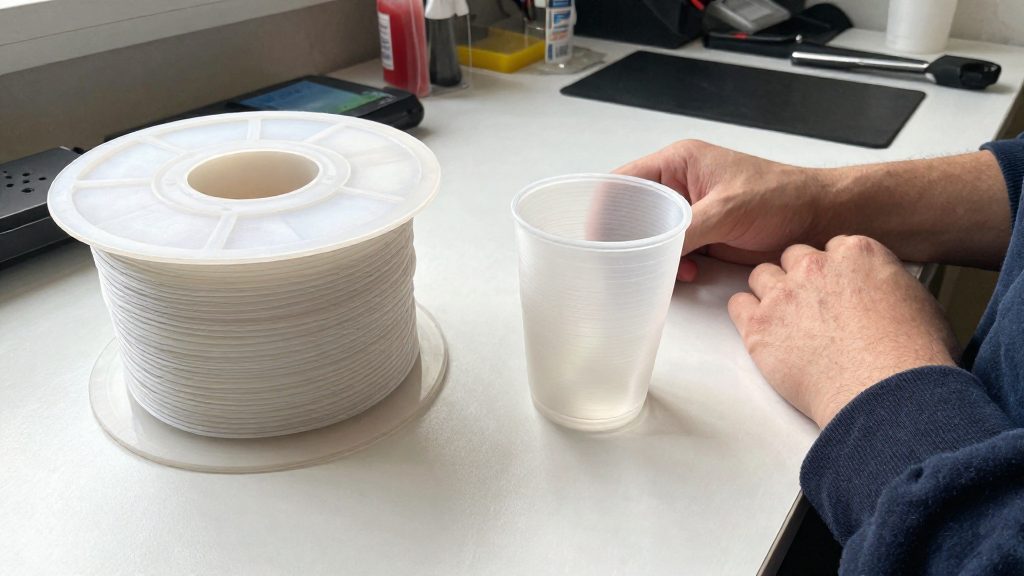
PETG is not automatically food safe for printing. Prusa Research warns that PETG filament is not automatically suitable for food-contact prints and recommends against using ordinary 3D prints as food containers. The polymer name identifies the base plastic, not whether a finished printed object is safe to hold food. Pigments, additives and the printing process each add their own risks, so a print can fall short even when the material is PETG.
Is PETG Food Safe for Printing?
The polymer name does not settle it
A filament labelled PETG tells you the base polymer, not the compliance of the finished part. colorFabb lists PETG Economy among products with food-contact-compliant raw materials, but states that this does not certify the filament manufacturing process or the filament itself (colorFabb, 2024-01-24). A compliant raw material and a compliant spool are therefore different claims. Check the manufacturer’s documentation for the exact product you buy.
Where the printing process adds risk
Prusa Research says the printing process introduces concerns beyond the raw material. Two process-related risks stand out:
- Layer grooves: the grooves between printed layers can retain food residue and support bacterial growth.
- Printer history: Formlabs warns that previously printed materials can contaminate printer components, so what a printer has run before matters for food-contact work.
A printed surface is also only as safe as its finish. Formlabs notes that food-contact coatings can degrade, expose the underlying print and may not withstand dishwashing.
No universal safe contact time, reuse count or hot-food temperature for home-printed PETG is established. That is not evidence that application-specific limits cannot exist. Treat any printed food-contact item as unvalidated unless its specific material and finish are documented for that use.
Manufacturer and regulator positions on PETG food contact differ in scope, from raw-material claims to warnings about printer and process contamination.
| Factor | Source | Stated position |
|---|---|---|
| Regulatory status | U.S. Food and Drug Administration | Depends on each constituent substance and its intended use, not on the polymer name |
| Pigments, additives, process | Prusa Research | Add concerns beyond the base polymer; ordinary prints are not recommended as food containers |
| Raw material compliance | colorFabb (2024-01-24) | PETG Economy uses food-contact-compliant raw materials; this does not certify the filament or its manufacturing process |
| Layer grooves | Prusa Research | Can retain food residue and support bacterial growth |
| Printer material history | Formlabs | Previously printed materials can contaminate printer components |
| Nozzle material | Prusa Research | Stainless steel or titanium nozzles recommended over brass, which wears faster |
| Food-contact coatings | Formlabs | Can degrade, expose the underlying print, and may not withstand dishwashing |
| Dental or medical resins | Formlabs | Certifications cover specific applications and do not automatically make a resin food-safe |
| Molding | Formlabs | Described as an indirect way to make custom food-contact items with 3D printing |
| Blanket FDA approval of all PETG | Not established | A blanket approval claim for all PETG filaments or prints is not supported |
What Does FDA Compliance Actually Cover?
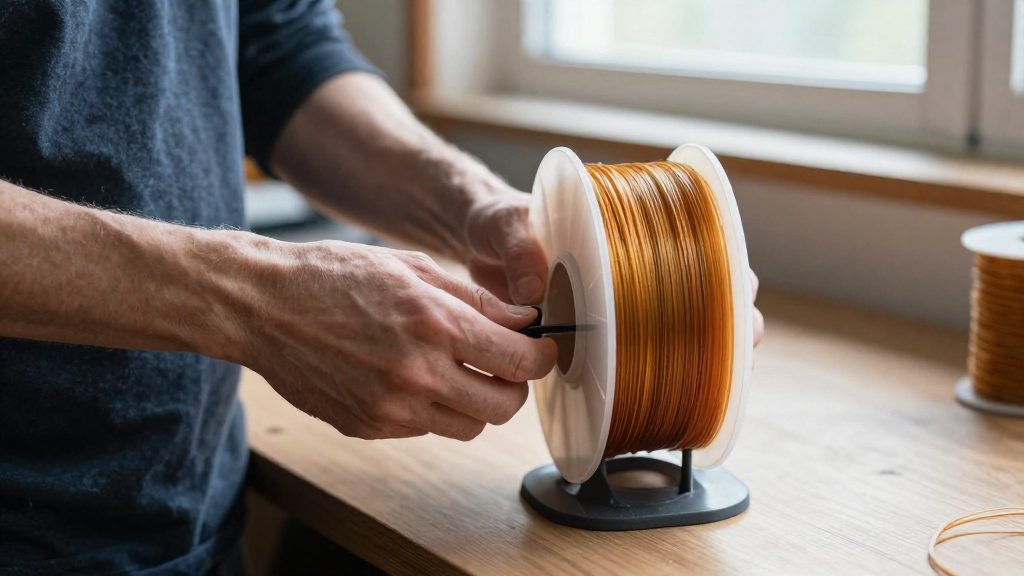
In the United States, food-contact status is not tied to a polymer name. According to the U.S. Food and Drug Administration, the regulatory status of a food-contact material depends on its individual constituent substances and their intended use. Calling a filament PETG therefore says little about whether a print can touch food. What matters is which substances the filament contains and what the material is meant to contact.
Status follows substances and intended use
- Each constituent substance is assessed for its specific conditions of use, not for the base polymer alone.
- The same material can be acceptable for one intended use and not for another, so a claim must name the use it covers.
- Being PETG is not, by itself, evidence of FDA approval.
A notification names a substance manufacturer, not a brand
A Food Contact Substance Notification applies to the identified substance manufacturer, the substance and the conditions of use. The filament brand does not need to be that manufacturer. Supply-chain coverage must be verified: when a filament brand cites a notification, confirm that the relevant substance comes from the named manufacturer and that the conditions of use match the intended application.
Requesting a letter of guaranty
The FDA states that customers may request a manufacturer’s letter of guaranty confirming that a particular product is acceptable for its intended food-contact use. To use this route, contact the filament manufacturer, identify the exact product and describe the planned food-contact use, then ask for a letter that references both. Keep the letter with the filament batch details so the document matches the product you actually print with.
Filament Additives and Printer Contamination
PETG is not automatically food-safe once it becomes a printed part. Contamination can enter at three points: the raw polymer, what is added during filament manufacture, and what the printer carried over from earlier jobs.
Compliant Raw Materials Do Not Certify the Filament
A compliant base resin says nothing about what the finished spool contains. For a food-contact print, request documentation that covers the finished filament, not only the raw polymer, and check the product label and the manufacturer’s instructions.
Pigments and Additives in the Filament
Pigments and additives are part of the filament formulation, so they cannot be assessed by looking at the print or by knowing the polymer name alone.
Contamination From Previously Printed Materials
The material history of a printer is relevant to any food-contact job, not only the material being loaded. Treat a printer that has run other materials as carrying that history into the next print, and confirm the intended use of the new filament before printing for food contact.
Layer Lines, Bacteria, and Cleaning
Every FDM print is built from stacked layers, and the boundary between two layers leaves a small layer groove on the surface. A smooth, solid surface gives food and moisture little to settle into, but a layered surface offers a series of valleys where they can collect.
Why Cleaning Gets Harder
A flat surface can be wiped in one pass. Residue sitting inside a groove is out of reach of a cloth or sponge that only touches the top of the layer, so cleaning has to address the whole surface profile rather than the visible face alone.
Research has measured microbial contamination and sanitization outcomes on FFF-printed specimens, including PETG, under specific experimental conditions (Study on the Sanitization Efficacy for Safe Use of 3D-Printed Parts for Food and Medical Applications, 2023). This does not establish universal safety for home prints.
Practical steps:
- Rinse food residue off the print as soon as contact ends, before it dries into the grooves.
- Inspect the surface under a bright light to locate the deepest layer lines, where residue is most likely to collect.
- Give priority attention to the area around these deep lines when cleaning.
Can Coatings Make PETG Prints Safe?
A coating can seal the surface of a PETG print, but a coating does not by itself make the print food-safe. Food-contact suitability depends on intended use and the complete material system: the coating, the PETG beneath it and how the coating is applied.
Sealing layer grooves and surface pores
A coating is one option for filling or covering layer grooves, but it covers the surface rather than the whole part, so the layer structure remains underneath.
Formlabs warns that a food-contact coating does not guarantee long-term food safety. A coating that cracks or wears through re-exposes the grooves it was meant to seal.
Effect on the underlying PETG food-contact status
A coating does not certify the PETG beneath it. Raw-material compliance does not transfer to the finished, coated object.
A coating adds its own substances, so it needs to be assessed separately. For a specific product, check the manufacturer’s documentation for the coating and the filament, and request a manufacturer’s letter of guaranty if you need written confirmation of intended food-contact use.
Durability under repeated food washing
Dishwashing is a durability concern for any surface washed after each use. No universal coating lifespan is established. Visual inspection alone does not establish continued food-contact suitability: visible cracks or peeling are reasons to stop using the part, but an intact appearance is not proof of safety. Repeated use requires documented suitability of the complete coated part and its cleaning process.
Cookie Cutters Versus Reusable Food Containers
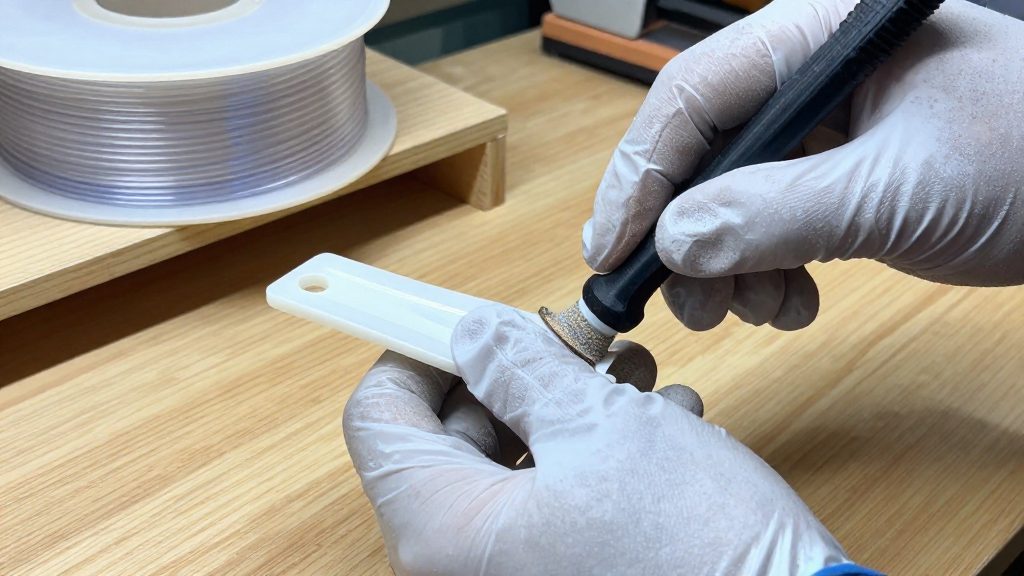
The main variable is how long food stays against the printed surface. A cookie cutter touches dough only while it is pressed, while a reusable container holds food for as long as it is stored and is washed again after each use. No universal safe contact duration for home-printed PETG is established; that is not evidence that application-specific limits cannot exist. The ranking below is therefore qualitative: brief contact is the lower-exposure case, and prolonged storage is the higher one.
Brief contact does not remove the material concerns. Check the filament’s food-contact claims on the product label or manufacturer’s instructions before using a print with dough.
Reusable containers carry the higher risk level. Food rests against the surface through repeated storage cycles, so any residue or surface change has more opportunity to matter.
Safer Alternatives for Custom Kitchen Projects
The simplest route is to avoid printing a food-contact surface altogether. The options below fall into two groups. Nozzle changes still leave a printed food-contact surface, so they address the printer but not the finished part. Commercial food-grade containers and non-food-contact prints avoid that exposure.
Upgrade the hardware: stainless or titanium nozzles
Prusa recommends stainless-steel or titanium nozzles when considering food-contact printing, citing wear from standard brass nozzles. This is a hardware-level change that addresses the printer, while the printed food-contact surface remains. Replacing the nozzle alone does not establish that a print is food-safe, and no measured nozzle-metal migration results are established.
Buy commercial food-grade containers
For storage, serving or cooking vessels, purchasing a commercially produced food-grade container is the most verifiable option. A commercial product can be checked against its manufacturer’s documentation, which is harder to do for a home print.
Print decorative, non-food items
Printing is well suited to items that do not touch food, such as decorative objects, labels, organisers, stands and holders placed beside the kitchen counter. These parts avoid the food-contact question entirely, provided they are not repurposed for food later.