Is PLA safe to print in a bedroom?
No, PLA is not a safe material to print in a bedroom. It generally produces fewer particles than ABS, but the authors of the main emissions study say it is “by no means safe for users, particularly when extruded at high temperatures.” A bedroom combines several conditions that raise exposure: the printer runs close to where people sleep, long prints can run unattended for hours, and everyone in the room breathes the same air.
Is PLA safe to print in a bedroom?
The authors’ warning
The study published in Sensors (Basel) via PubMed Central (2023-12-06) does not treat PLA as a harmless material. Its authors say home printers are often used in poorly ventilated spaces, without enclosures or personal protective equipment, and they call for better ventilation and careful choice of filament and brand. Those conditions describe a typical bedroom setup.
Engadget (2026-10-11) reaches the same practical conclusion. It advises against printing in a bedroom, especially overnight, and recommends a separate room or workshop that exhausts air outdoors.
Who is exposed
- People sleeping in the room: they breathe the air for the full length of the print, often without the printer being watched.
- People nearby: anyone in the same room or in an adjoining space with shared air is exposed, not only the person using the printer.
- Children and pets: the sources consulted do not specify exposure thresholds for children, pets or people nearby, so no safe distance can be stated.
Low-risk claims versus real exposure
Relative claims about PLA are easy to misread as safety claims. The table below separates what each source says from what it does not establish.
| Claim | Source | What it does not establish |
|---|---|---|
| PLA generally produces fewer particles than ABS | Engadget (2026-10-11) | A relative comparison, not an exposure limit |
| Lactide is not listed as a major indoor air quality hazard | Sensors (Basel) via PubMed Central (2023-12-06) | — |
| PLA is usually the safer filament | Engadget (2026-10-11) | A ranking of typical filaments, not an exposure limit |
A low-risk label describes a material compared with others, under specific conditions. It does not describe what a sleeping person breathes over an eight-hour print in a closed room.
What PLA actually emits when heated
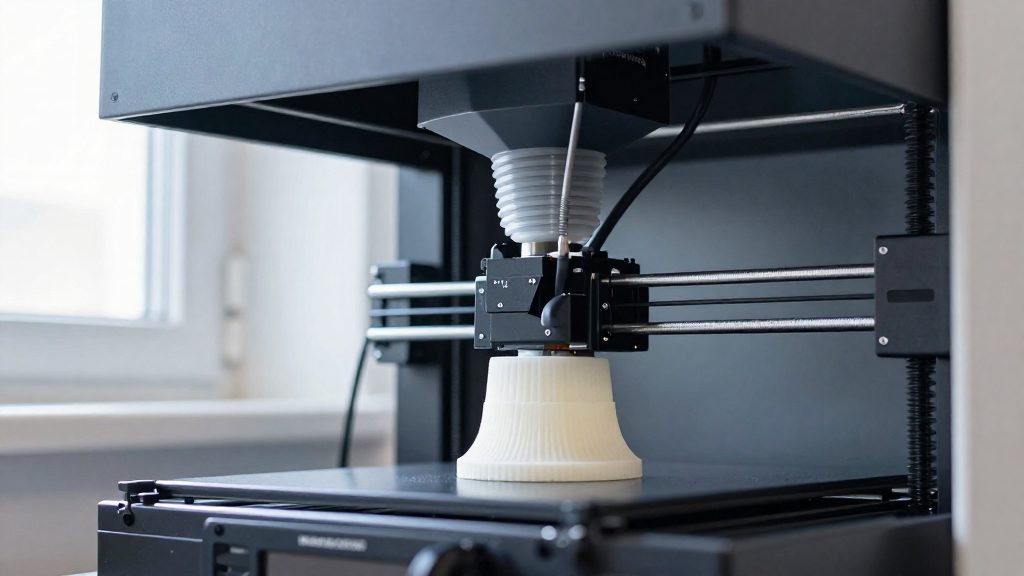
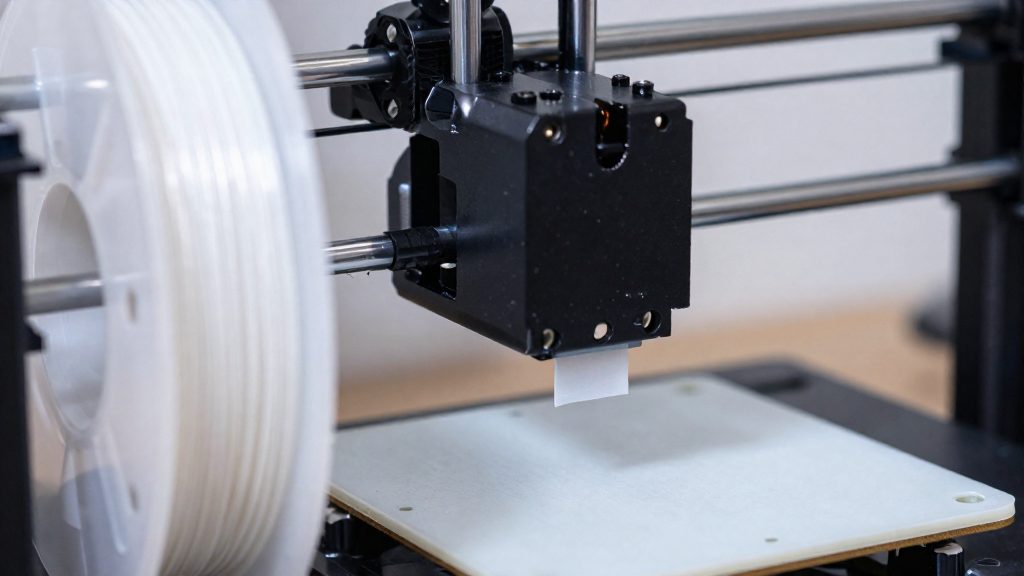
Heating PLA releases both particles and gases, and the output changes during a print. The most detailed measurements come from a 2023 study in Sensors (Basel) that tracked particle counts and volatile organic compounds (VOCs) across several PLA filaments.
Lactide is the main gas. It is a residual monomer, a leftover building block of the polymer, and it is released when the filament melts. In that study, lactide was the most abundant VOC from every PLA filament tested. Nozzle temperature also affects the output.
Particle emissions peak early. Particle counts peaked in the first 5 minutes of printing and then declined. The highest PLA reading was about 250,940 particles/m³, from an Eryone black filament. Particles below 0.5 µm fell under the instrument’s detection limit, so the reported figures cover larger particles only.
Bed glue and bed heating are a separate source, independent of the filament. The study’s glue-only control produced about 126,752 particles/m³, roughly half the peak PLA reading. Bed glue and bed heating alone generated notable particle emissions, so the heated bed adds to the room’s particle load even when the filament itself is the same.
| Emission source | Reported figure | Context |
|---|---|---|
| PLA filament (Eryone black) | About 250,940 particles/m³ | Highest PLA reading; peak in first 5 minutes |
| Glue-only control | About 126,752 particles/m³ | Bed glue and bed heating alone |
| Particles below 0.5 µm | Below detection limit | Not quantified in the study |
Is PLA safer than ABS or PETG?
According to Engadget (2026-10-11), PLA generally produces fewer particles than ABS, which makes it the lower-emission choice of the two common home filaments. It does not make PLA emission-free. The same report notes that even PLA releases airborne particles and gases when heated, so the comparison is relative: PLA is usually the less emissive option, not a safe one in every setup.
The result is not fixed for the whole material. Emissions differ by brand, nozzle temperature and additives. Two PLA spools can behave differently, and one spool can emit more at a higher nozzle temperature. In practice:
- Treat “PLA” as a category, not a guarantee of low emissions. Two products with the same label can differ.
- Do not set the nozzle higher than the filament requires, since temperature changes the result.
- Expect additives, which vary by product, to be one reason two PLAs differ.
The comparison has clear limits. The sources consulted give no PETG emission figures, so PETG cannot be placed on the same scale as PLA and ABS. The ABS comparison is also qualitative: the sources give a general ranking, not side-by-side measurements, so no ratio between the materials can be calculated.
Why bedrooms are a poor spot for a printer
A bedroom combines three conditions that make printer emissions harder to avoid: people spend hours in the room, the printer may run while they sleep, and everyone in the room breathes the same air. The concern is less about one short print than about accumulated exposure in the same air over time.
Sleeping hours and unattended sessions
Overnight printing is the case of greatest concern, because a long job can run for many hours while people sleep in the room and nobody is watching the printer. In the Sensors study, particle counts peaked in the first 5 minutes of printing and then declined, so emissions do not stay constant through a session.
Shared air with people, pets and children
The air in a bedroom is shared by everyone who sleeps there. Everyone in the room shares the same exposure.
Bedroom air volume and enclosed rooms
The Sensors authors call for improved ventilation but give no specific ventilation rates. An open window alone does not reliably remove particles and gases, according to Engadget. A closed enclosed room therefore offers emissions no reliable exit, and the air people breathe while sleeping is the air the printer is filling.
How to reduce risk if you must print indoors
If a bedroom is the only place to print, the sources do not show that any measure makes it safe there. Engadget says an enclosure with ducted exhaust captures emissions near the source, but no capture efficiency is given. Their guidance is to move printing out of the sleeping area and to move air out of the building. Engadget (2026-10-11) says an enclosure with ducted exhaust captures emissions near the source.
The two measures the sources support are compared below.
| Measure | What the source says |
|---|---|
| Separate room or workshop with outdoor exhaust | Keeps emissions out of the room where you sleep. |
| Enclosure with ducted exhaust | Captures emissions near the printer, before they reach the rest of the room. |
Choose a room you do not sleep in, and make sure air from it leaves the building rather than recirculating. Do not leave the printer running unattended in a room you occupy. The sources do not give a safe distance from the printer.
Material and settings also matter. Emissions depend on nozzle temperature, so avoid setting it higher than the filament requires. The sources do not quantify how much a lower setting reduces emissions.
Do HEPA and carbon filters help?
HEPA and carbon filters can capture part of what a printer releases, but they do not make a poorly ventilated room safe. According to Engadget (2026-10-11), neither filter type achieves this.
HEPA filters are designed to capture airborne particles. Engadget (2026-10-11) confirms this role but gives no capture efficiency for the particles a PLA printer emits. The Sensors study (2023-12-06) could not measure particles below 0.5 µm, because they fell below the instrument’s detection limit. The study therefore does not establish how well any filter performs on the smallest particles.
Activated carbon can filter some VOCs, according to Engadget (2026-10-11). The evidence for PLA is limited. The sources consulted do not give carbon removal rates for PLA emissions.
Filtration works best as a supplement to ventilation, not a substitute. Engadget (2026-10-11) states that an enclosure with ducted exhaust captures emissions near the source, which a filter alone cannot do.
What about resin printers? Check the SDS and manual
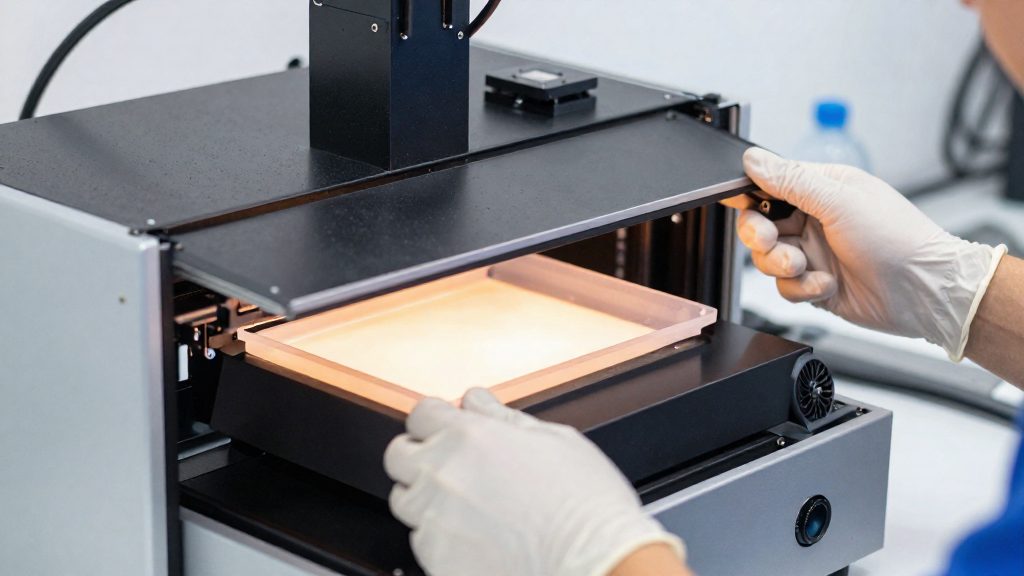
The emission findings discussed above apply to heated filament printing and do not transfer to resin printers. Resin machines cure liquid photopolymer resin with UV light, a different process from melting thermoplastic filament. The official sources consulted do not specify which airborne particles or vapours resins release during printing, washing or curing, so no emission rate or exposure level can be stated for resin.
Fire safety is also outside the sources consulted. They do not specify flammability ratings, flash points or fire-related handling guidance for resins or for resin printers. Any statement about fire risk for a resin setup would therefore be unsupported here.
The practical starting point is the documentation for the specific product:
- Safety data sheet (SDS): The resin manufacturer publishes an SDS for each product. It lists that resin’s hazards, handling precautions and fire-related information, and it is the only reliable reference for those points.
- Printer manual: Check the manufacturer’s instructions for placement, ventilation requirements and any warnings about leaving the machine running unattended.
- Storage: Keep uncured resin in its original container, sealed and away from heat sources.
Do not rely on the PLA particle counts or VOC results for resin decisions. Those results describe filament printing only, so a resin printer needs its own assessment based on its SDS and manual.
Frequently asked questions
Is PETG or ABS a safer choice than PLA for a bedroom printer?
Engadget (2026-10-11) reports that PLA generally produces fewer particles than ABS, so ABS is the higher-emission option in that comparison. The official sources consulted give no PETG emission data, so PETG cannot be ranked against PLA. Neither material is shown to be safe for bedroom use.
Does the early emission peak mean the risk drops after a few minutes?
In the Sensors (Basel) study, particle counts peaked in the first five minutes and then declined. That pattern does not show that the rest of a print is low-emission, so the early emission peak should not be read as the end of the risk. The study does not give an exposure threshold for later stages.
Is overnight printing the only bedroom scenario to avoid?
Engadget (2026-10-11) singles out overnight printing as the case to avoid, but it advises against bedroom printing in general, not only at night. No consulted source presents daytime printing in a bedroom as acceptable. The official sources consulted do not specify a daytime exposure limit.