Build volume is the printable envelope of a resin printer, expressed as width × depth × height in millimeters. Among the models compared here, the Peopoly Phenom XXL V2 has the largest verified build volume, at 527 × 296 × 550 mm.
Which of These Four Resin Printers Has the Largest Build Volume?
What Build Volume Measures
Build volume is the maximum space a printer can fill, calculated by multiplying width, depth and height. A part must fit inside those three dimensions in the orientation you choose, so the figure sets an upper limit for object size.
Manufacturers state these dimensions on their product pages, and the values can differ by region and by how they are rounded.
Manufacturer-Listed Dimensions
The table below lists the build volumes as stated by each manufacturer or regional website.
| Model | Build volume (W × D × H) | Listed by |
|---|---|---|
| Peopoly Phenom XXL V2 | 527 × 296 × 550 mm | Peopoly |
| EMAKE3D Galaxy 1 | 400 × 200 × 400 mm | EMAKE3D (advertised) |
| Phrozen Sonic Mega 8K V2 | 330 × 185 × 400 mm | Phrozen (2024-07-02) |
| ELEGOO Jupiter 2 | 302 × 162 × 300 mm | ELEGOO US website |
Peopoly gives 527 × 296 × 550 mm in its product description and 527.04 × 296.46 × 550 mm in its technical specifications. The table uses the rounded figures, so the difference is about 0.04 mm in width and 0.46 mm in depth.
Why an Absolute Largest Model Cannot Be Confirmed
Four limits prevent a definitive ranking of the largest consumer resin printer:
- Category boundaries: Consumer and professional printers have no consistent dividing line, so a model can be compared in one category and excluded from another.
- Roundup accuracy: Roundup articles naming the ELEGOO Jupiter 2 or the Phrozen Sonic Mega 8K S as the largest consumer option did not establish a comprehensive comparison, and some contradicted their own listed dimensions.
- Stock status: Peopoly’s product page displayed “Sold out” at the time of checking. EMAKE3D’s Galaxy 1 page still links to a Kickstarter campaign.
- Scope: The four models above are the only ones with verified dimensions here. Other large-format resin printers were not compared, so the Phenom XXL V2 is the largest among these models only.
Large Resin Printers Compared
Ranked by the volume calculated from each manufacturer’s listed build dimensions, the Peopoly Phenom XXL V2 has the largest build volume of the four resin printers compared here, at about 85.8 liters. The EMAKE3D Galaxy 1 follows at 32 liters, then the Phrozen Sonic Mega 8K V2 at 24.42 liters and the ELEGOO Jupiter 2 at 14.68 liters. This ranking reflects calculated volume, not claimed records.
| Rank | Printer | Maker | Build volume (mm) | Calculation (mm³) | Volume (liters) |
|---|---|---|---|---|---|
| 1 | Phenom XXL V2 | Peopoly | 527 × 296 × 550 | 85,795,600 | 85.8 |
| 2 | Galaxy 1 | EMAKE3D | 400 × 200 × 400 | 32,000,000 | 32 |
| 3 | Sonic Mega 8K V2 | Phrozen | 330 × 185 × 400 | 24,420,000 | 24.42 |
| 4 | Jupiter 2 | ELEGOO | 302 × 162 × 300 | 14,677,200 | 14.68 |
How the dimension-to-volume conversion works
Each volume is width × depth × height in millimeters, giving cubic millimeters. Dividing by 1,000,000 converts the result to liters, since one liter equals 1,000,000 mm³. For the Jupiter 2, 302 × 162 × 300 = 14,677,200 mm³, or 14.68 liters.
The 85.8-liter figure uses the rounded description values. The Galaxy 1 dimensions are EMAKE3D’s advertised figures, and the Sonic Mega 8K V2 dimensions are those published by Phrozen in 2024.
Is the Phenom XXL V2 Practical at Home?
Peopoly lists the Phenom XXL V2 at 150 kg, so its weight is the main factor in deciding whether it suits a home setup. For comparison, Tom’s Hardware reports that the ELEGOO Jupiter 2 weighs 40 kg (2026-06-07), so the Phenom XXL V2 is about 3.75 times heavier.
Placement and floor capacity
A machine this heavy needs a sturdy, level surface. Before delivery, confirm that the floor and the table or stand can carry the load, particularly in rooms above ground level. Keep the printer away from areas where it could be bumped or knocked, because a heavy machine that shifts during a print can disturb the level of the build plate and the resin vat.
Delivery and handling
Plan the move before the machine arrives. At 150 kg, one person should not attempt to lift or reposition it alone. Arrange help with a flat, clear route from the entrance to the final position, and check the unpacking steps in Peopoly’s manual before opening the crate.
Availability
Peopoly’s product page displayed “Sold out” at the time of checking. Confirm current US stock and delivery with the seller before arranging space or help for the delivery.
Galaxy 1 and Sonic Mega Alternatives
The Galaxy 1 from EMAKE3D and the Sonic Mega 8K V2 from Phrozen are the two smaller resin printers covered here. Both list a 400 mm build height, so the difference lies in the build plate. The Galaxy 1 offers a 400 × 200 mm plate, and the Sonic Mega 8K V2 offers 330 × 185 mm.
| Model | Build volume (X × Y × Z) | Volume | Source |
|---|---|---|---|
| Galaxy 1 | 400 × 200 × 400 mm | 32 liters | EMAKE3D (advertised) |
| Sonic Mega 8K V2 | 330 × 185 × 400 mm | 24.42 liters | Phrozen, 2024-07-02 |
Height and plate area
Both machines share the same 400 mm Z height, so vertical clearance is not a differentiator between them. The plate area is about 80,000 mm² on the Galaxy 1 (400 × 200) and about 61,050 mm² on the Sonic Mega 8K V2 (330 × 185). The Galaxy 1 therefore has roughly 31 percent more plate area and a 32-liter volume against 24.42 liters.
Footprint
The sources give build volumes only, not the external dimensions of either printer. Check the manufacturer’s specification page for the machine footprint before choosing a shelf or enclosure.
Where the Jupiter 2 Fits
The ELEGOO Jupiter 2 has the smallest build plate of the four resin printers compared here, and it is lighter than the Peopoly Phenom XXL V2. Tom’s Hardware (2026-06-07) reports that the Jupiter 2 weighs 40 kg and measures 465 × 508.1 × 648 mm with its doors closed. Peopoly lists the Phenom XXL V2 at 150 kg, so the Jupiter 2 is the easier of the two to move and place on a bench.
Build footprint against the other three models
The build volume sets the printable area, and the Jupiter 2 is the smallest of the four in both X and Y.
| Model | Build volume X × Y × Z (mm) | Source |
|---|---|---|
| ELEGOO Jupiter 2 | 302 × 162 × 300 | ELEGOO US (undated) |
| Phrozen Sonic Mega 8K V2 | 330 × 185 × 400 | Phrozen (2024-07-02) |
| EMAKE3D Galaxy 1 | 400 × 200 × 400 | EMAKE3D |
| Peopoly Phenom XXL V2 | 527 × 296 × 550 | Peopoly |
The Phenom XXL V2 sits at the other end of the range, with the largest verified build volume among these four.
Source date limits for the Jupiter 2 dimensions
The 465 × 508.1 × 648 mm and 40 kg figures rest on a single Tom’s Hardware article dated 2026-06-07. The sources contain no ELEGOO figure for external dimensions, and no external dimensions or weights for the Galaxy 1 or the Sonic Mega 8K V2, so a like-for-like footprint comparison is not possible. The ELEGOO US build volume page carries no date in the sources.
Build Volume Versus Print Detail
At the same LCD pixel count, a larger XY build area produces a coarser pixel pitch. Printers can use different pixel counts, and increasing build height does not change XY pixel pitch. Manufacturer-listed pixel pitch is useful for comparison, but it does not establish achievable print detail by itself. Among the three models compared here, the largest build volume comes with the coarsest listed pixel pitch.
| Model | Build volume (calculated) | Screen and XY resolution | Source |
|---|---|---|---|
| Phenom XXL V2 | 85.8 L | 23.8-inch 4K LCD, 137 µm pixel pitch | Peopoly |
| Sonic Mega 8K V2 | 24.42 L | 43 µm XY resolution | Phrozen (2024-07-02) |
| Jupiter 2 | 14.68 L | 20 × 26 µm XY resolution | ELEGOO US |
The Sonic Mega 8K V2 and the Jupiter 2 trade volume for finer detail. The Jupiter 2 has the finest listed XY value of the three, but the smallest build area.
Pixel pitch is the spacing between LCD pixels, and the manufacturer XY figure is the value to compare across printers. These are manufacturer specifications, not independent test results, so verify any figure you rely on against the product page or the manufacturer’s documentation.
Planning Space for Washing and Curing
Planning the wash and cure area starts with the largest part the printer can make. The Phenom XXL V2 from Peopoly specifies a 527 × 296 × 550 mm build volume, so a finished print can be up to 550 mm tall. Plan the workflow around the build volume, not the typical part size.
Footprint for wash and cure stations near the printer
- Place the wash station and cure unit on a level, stable surface within arm’s reach of the printer, so the build plate travels a short path.
- Keep a clear path above the wash station for lifting the print straight out of the vat, without tilting it.
- Measure the interior height of the cure unit before purchase. A 550 mm tall print needs a cure chamber that is at least that tall, and a tall part that does not fit will have to be cut or cured in sections.
Resin handling and ventilation in the curing area
- Store uncured resin in its original sealed bottle, away from the printer and cure unit, and wipe spills immediately.
- Set up the curing area in a room with airflow. Check the resin manufacturer’s safety data sheet for its ventilation and glove requirements, since these vary by product.
- Keep a dedicated container or tray under the printer and wash station to catch drips, so resin does not reach the floor or work surface.
Moving larger prints from the build plate to curing
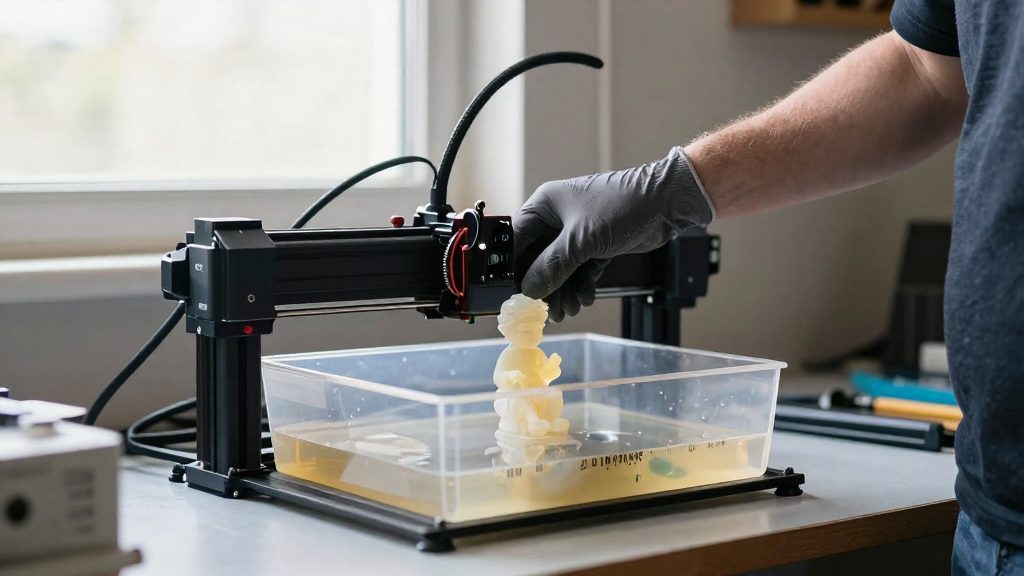
- Let the print drain over the vat until resin stops dripping from the part.
- Release the build plate and lift it with both hands, supporting the print underneath so it does not flex or drop.
- Lower the print into the wash container, keeping it upright along its height.
- After washing, let the part dry completely in an appropriately ventilated area, following the solvent and equipment instructions. Then transfer it to the cure unit, supporting it along its full length to avoid stress on thin features.