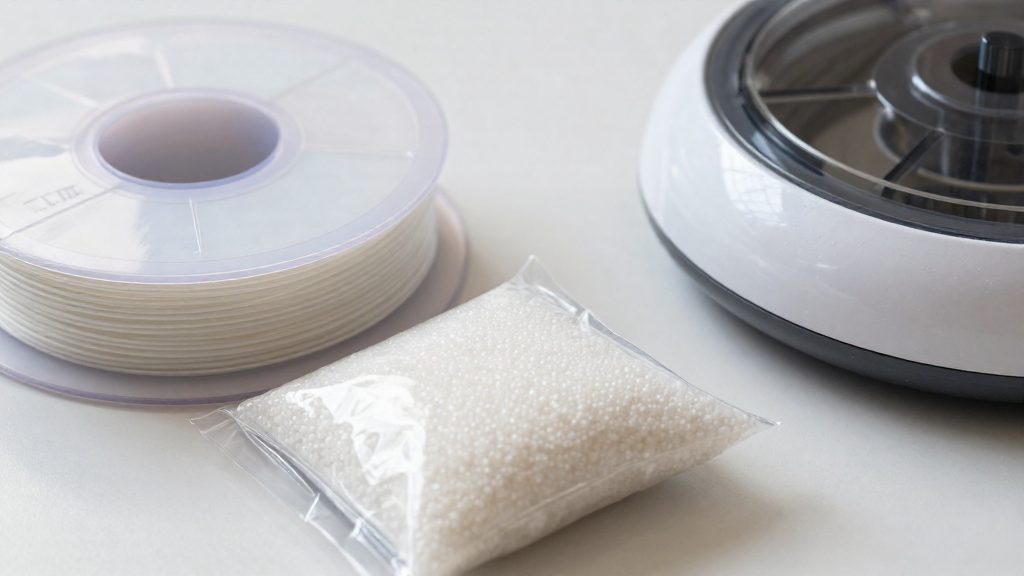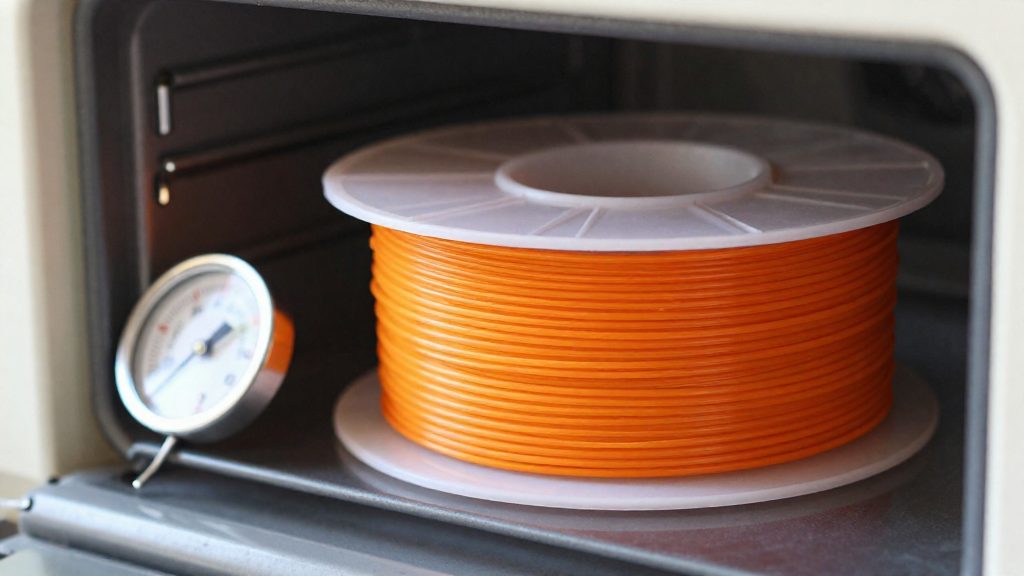
PETG filament absorbs moisture from the surrounding air, and that water has to be removed before the filament reaches the extruder. Drying in a home oven is a practical option for a spool that has been left open or stored in humid conditions, but the process only works with close control of temperature and time. How quickly a spool becomes wet depends on how long it has been exposed to air.
Why dry PETG filament?
How PETG absorbs moisture from ambient air
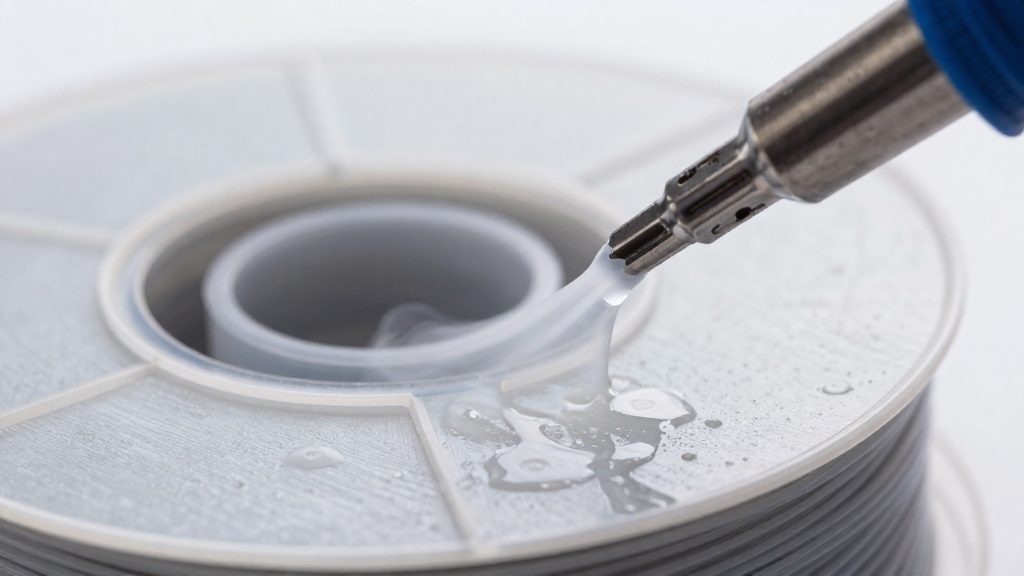
A spool left out of its sealed packaging gradually takes up water vapour from the room. The risk rises with exposure time and with the humidity of the room. Once a spool has been exposed, the moisture stays in the filament until it is heated out, and simply leaving the spool in a dry room will not reverse it.
Why water must leave the filament before extrusion
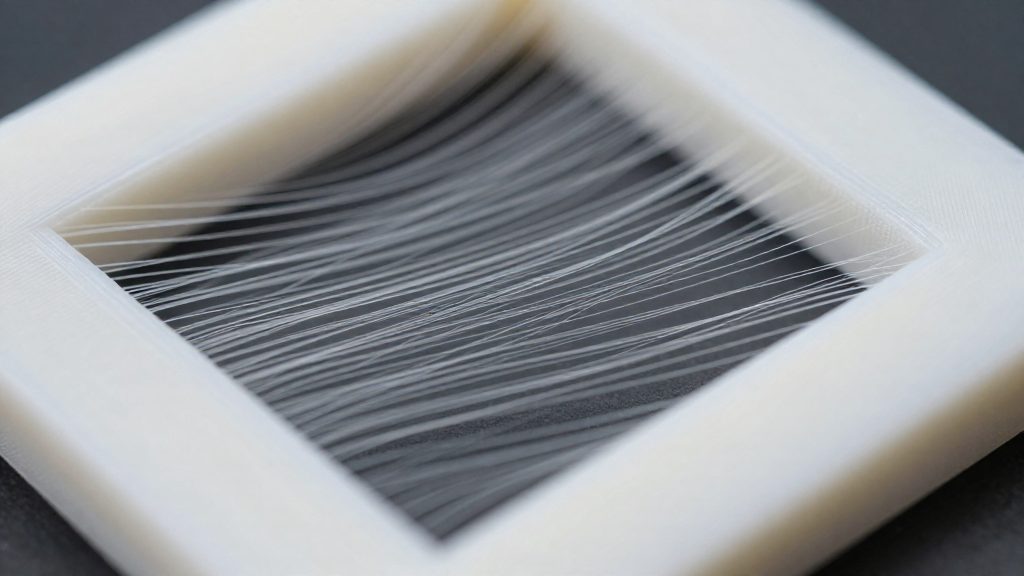
Water trapped in the filament turns to vapour when the filament is heated in the extruder’s melt zone. Drying removes that water before the filament is melted, so the extruder works with dry material. Drying is therefore a preparation step, not a repair you can apply during printing.
When a stored spool needs drying
A spool needs drying when it has been exposed to humid air, and the length of the cycle depends on how long that exposure lasted. According to Overture (2026), the following drying times apply:
| Exposure condition | Suggested drying time |
|---|---|
| Moderately exposed filament | 4–6 hours |
| Long humid exposure | 8–10 hours |
Before heating a spool, check the heat rating of the spool itself: older black Prusament spools can loosen above 45°C unless the sides are screwed together (PrintPal, 2026).
Is it safe to dry PETG in a kitchen oven?
A kitchen oven can dry PETG, but it is a last resort. According to PrintPal (2026), home ovens are imprecise, and many cannot be set low enough for filament drying. The temperature on the dial may not match the temperature the spool actually sees.
The two limits that matter most are the spool heat tolerance and the polymer’s own softening point:
| Limit | Figure | Source |
|---|---|---|
| Older black Prusament spools | Can loosen above 45°C unless the sides are screwed together | PrintPal (2026) |
| Recommended drying ceiling | Stop at 70°C or below | Overture (2026) |
| PETG glass transition | About 80°C | Overture (2026) |
The glass transition is the risk that matters most in an oven. Overture notes that approaching it can fuse adjacent wraps on the spool, which then cannot be unwound cleanly. The 70°C ceiling leaves a margin below that point, but only if the oven actually holds the setting you chose. Because many ovens drift, the cabinet can run hotter than the dial suggests.
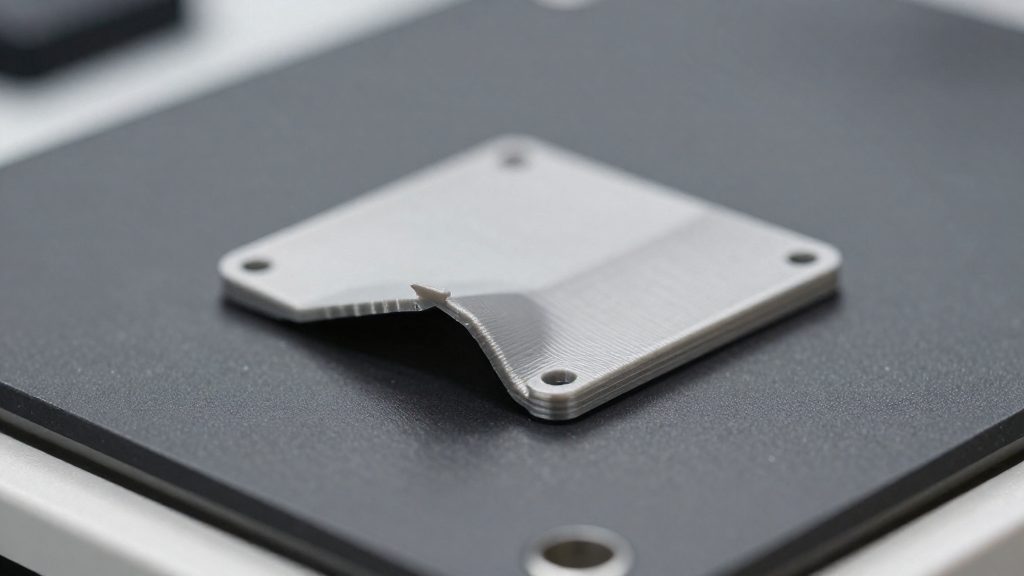
Never leave the oven unattended during drying. A spool that deforms or whose windings stick together has already exceeded its tolerance, and the cycle needs to stop at that point. Do not compensate by raising the temperature to shorten the run.
If you must use an oven, set it to its lowest available setting. Overture points out that most kitchen ovens are not calibrated for low temperatures, which is why the lowest setting may still run warmer than intended.
What you need before you start
Before a PETG drying cycle, you need an independent oven thermometer and a kitchen scale, plus a dehydrator kept for filament only if you use one instead of an oven. A hygrometer is useful for the storage stage. Flashforge (2026) and PrintPal (2026) both treat the oven dial as an unverified setting, so the measurements come from your own tools.
Independent oven thermometer
Household ovens can overshoot the set temperature, so the dial alone is not a reliable measurement. Place a separate digital thermometer inside the oven.
Kitchen scale
Note the starting weight so the comparison is meaningful.
Dedicated filament dehydrator
If you use a dehydrator instead of an oven, reserve it for filament. Flashforge (2026) advises keeping any dehydrator used for filament separate from food preparation. Keep that unit separate from food preparation.
Hygrometer
A hygrometer placed near the spool shows the humidity of the storage container after drying. Flashforge (2026) recommends a relative humidity of 20% or less for HS PETG and PETG-CF.
Heat sources to avoid
How do you dry PETG in an oven step by step?
Drying PETG in an oven depends on four habits: preheating fully, keeping the spool clear of the heat source, leaving a vent open, and never raising the temperature to speed things up. Follow these steps in order.
-
Preheat the oven fully. Switch the oven on and wait until it has reached its set temperature before the spool goes in. Flashforge (2026) advises preheating first.
-
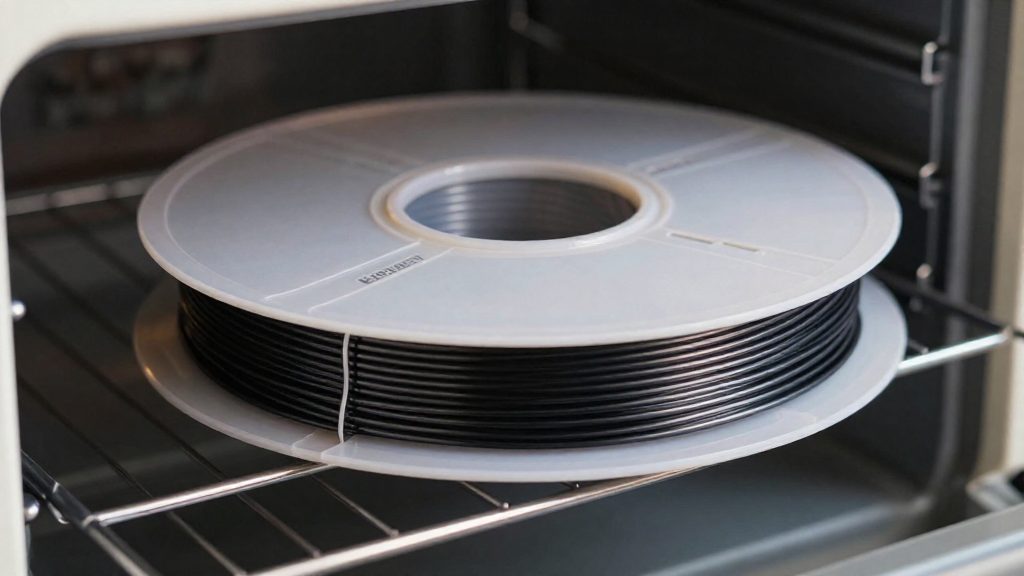
Keep the spool away from the elements. Place it on a baking sheet, positioned clear of the heating elements. Overture (2026) suggests this approach for a kitchen oven.
-
Open the vent. Leave the oven vent open during the whole cycle so moisture can escape from around the spool.
-
Hold the temperature. If you want the cycle to finish sooner, do not raise the heat. Flashforge (2026) is explicit that a higher temperature is not a shortcut.
-
Stay nearby. PrintPal (2026) advises never leaving a kitchen oven unattended. Check the spool periodically during the cycle.
What temperature and time suit PETG?
PETG drying generally falls within 55–70°C for 5–8 hours according to Flashforge, and the exact setting depends on the formulation. Other sources give 4–6 hours (extendable to 8 hours) or up to 10 hours after long humid exposure, so the figures below are starting points. The spool label or datasheet always takes priority over any general range. Brands publish different figures: Flashforge (2026) lists 70°C for 5 hours for its HS PETG and PETG-CF, while PrintPal (2026) gives 60–70°C for 4–6 hours, extendable to 8 hours.
The table below collects the published settings by product or brand.
| Product or source | Temperature | Time |
|---|---|---|
| Flashforge HS PETG and PETG-CF | 70°C | 5 h |
| Prusa, as cited by PrintPal | 55°C | 6 h |
| Bambu Lab, as cited by PrintPal | 70°C | 8 h |
| PETG-HF and translucent PETG | 65°C | 8 h |
| Overture, moderately exposed filament | 60–65°C | 4–6 h |
| Overture, after long humid exposure | 60–65°C | 8–10 h |
Use the shortest time that matches your spool’s condition, and follow the label or datasheet first. According to Overture, moderately exposed filament needs 4–6 hours at 60–65°C, and filament after long humid exposure needs 8–10 hours.
Temperature limits for PETG
PETG has a glass transition of about 80°C. Above this point the plastic softens, and adjacent wraps on the spool can fuse together. Overture advises staying at 60–65°C (140–149°F) and stopping at 70°C or below, which leaves a safety margin below the glass transition.
Time has a limit too. Overture notes that drying beyond about 24 hours can make the filament brittle, so a longer cycle does not improve results.
How do you know the filament is dry?
Weighing the spool before and after drying is a useful check on whether the cycle removed moisture, but it cannot on its own prove the filament is dry. Weigh it before it goes into the oven, then weigh it again after the cycle, once it has cooled. PrintPal (2026) recommends this before-and-after comparison.
Weighing the spool before and after drying
Record the mass of the full spool, with filament still wound, before heating. Use the same scale and the same spool for the second reading so the two figures can be compared. Let the spool cool completely before weighing it again, because a warm spool gives an unreliable reading. The difference between the two readings is the mass that left the filament during drying.
Drying time depends on how much moisture the filament has absorbed. Overture (2026) suggests 4–6 hours for moderately exposed filament and 8–10 hours after long humid exposure. Use these durations as starting points, then use the weighing comparison to see whether the spool lost mass rather than relying on the timer alone.
Compare the new reading with the starting reading and record both, so you can see how much mass was lost in that cycle. Use the two readings as a reference for your own spool rather than a target mass.
Print defects that signal residual moisture
Use the weighing comparison as the decision point before printing. A spool whose before-and-after readings you have recorded gives you a documented basis for deciding whether to print or dry it again.
How to store PETG after drying
A dried PETG spool can take on moisture again if it sits open on a shelf, so storage matters as much as the drying cycle itself. According to Flashforge (2026), the spool should go into storage only after it has cooled. Once cool, it needs an airtight seal with a moisture absorber, and a way to confirm that the humidity inside stays low.
Sealing the spool
- Let the spool cool fully after it comes out of the oven.
- Place it in an airtight container with desiccant.
- Close the lid so the spool is fully enclosed, with no open gaps around the lid.
Seal the spool only once it has cooled, as Flashforge advises, so do not skip the cooling step.
Monitoring humidity
Flashforge recommends keeping the relative humidity at 20% relative humidity or less for HS PETG and PETG-CF. The target applies to the air around the spool, so the number is only useful if you measure it.
To check it, place a hygrometer next to the spool inside the sealed container. Read the display before you use the filament, and if the reading rises above 20%, the desiccant may need to be refreshed or replaced before the spool goes back on the printer.
Frequently asked questions
Can I speed up PETG drying by raising the oven temperature?
No. Flashforge advises against raising the temperature to shorten the cycle. Overture recommends staying at or below 70°C, because PETG’s glass transition of about 80°C can fuse adjacent wraps on the spool.
How long is too long to leave PETG in the oven?
According to Overture (2026), drying beyond about 24 hours can make the filament brittle, so keep the cycle within the time range for your level of exposure. Weighing the spool before and after drying is PrintPal’s check for dryness (PrintPal, 2026).
How should I store the spool after drying?
Let the spool cool, then seal it in an airtight container with desiccant. According to Flashforge (2026), HS PETG and PETG-CF should be kept at 20% relative humidity or less, so place a hygrometer near the spool to check.